103 Korean martyrs is a saint of the Catholic Church. 103 Korean martyrs's feast day is celebrated on September 20.
Paris Foreign Missions Society
License: Public domain
103 Korean martyrs
Saint- Feast Day
- September 20
- Church
- Catholic
Places
Roles & Family
Canonization
Biography
The 103 Korean Martyrs are a group of Catholic men and women put to death for their faith in Korea during the nineteenth century and canonized together in 1984. The Catholic community in Korea had an unusual beginning. In the late eighteenth century, members of the Korean scholarly elite encountered Catholic books in China and formed a church without resident foreign missionaries. Yi Seung-hun was baptized in Beijing in 1784 and, on returning home, baptized others. The new religion spread among yangban scholars and commoners alike, but it soon collided with the Confucian ritual and political order of the Joseon dynasty, above all because Catholics refused to perform ancestral rites. Repeated edicts and campaigns of suppression followed, including major persecutions in 1801, 1839, 1846, and 1866. Thousands of Korean Christians are estimated to have died in those waves of violence; the 103 commemorated as a group are those whose lives and deaths could be documented with sufficient historical certainty for the Church’s processes of beatification and canonization.
They include victims of the Gihae persecution of 1839, the Byeongo persecution of 1846, and the Byeongin persecution that began in 1866, together with related episodes. Among the best known is Saint Andrew Kim Taegon (Kim Dae-geon), born in 1821 into a family already marked by martyrdom. He studied abroad, was ordained in Shanghai in 1845 as the first Korean-born Catholic priest, and after returning to Korea was arrested and beheaded at Saenamteo in Seoul on 16 September 1846. Saint Paul Chong Hasang, a lay catechist and son of the earlier martyr Augustine Chong Yak-jong, spent years seeking priests for Korea, writing to Rome and traveling toward Beijing; he was executed in 1839. Many other Korean laypeople of both sexes and of widely differing ages and social ranks—nobles, farmers, widows, married couples, and young women who had dedicated themselves to the Church—were likewise killed. Methods of execution commonly included beheading and strangulation. The group as a whole comprises bishops and priests as well as a large majority of lay faithful; none of the 103 held the papacy or a patriarchal see.
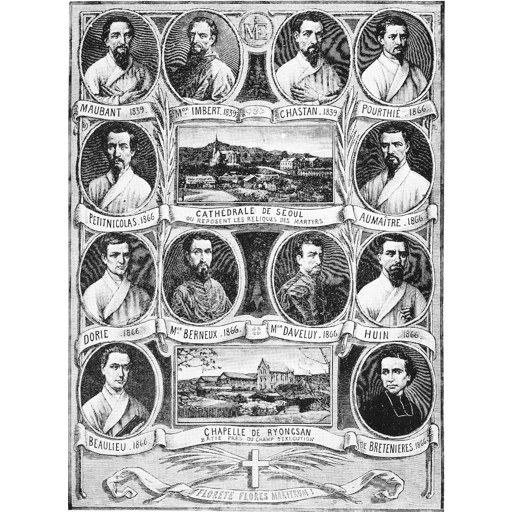
Foreign clergy of the Paris Foreign Missions Society (Société des Missions Étrangères de Paris) also belong to the 103. Bishop Laurent-Joseph-Marius Imbert and Fathers Pierre-Philibert Maubant and Jacques-Honoré Chastan entered Korea in disguise in the 1830s, administered the sacraments under conditions of secrecy, and were arrested during the 1839 persecution and beheaded. In the 1860s Bishop Siméon-François Berneux, Bishop Antoine-Marie-Nicolas Daveluy, and several other French priests were captured and put to death during the great persecution that began in 1866 under the regency of the Heungseon Daewongun, a campaign bound up with court fear of Western influence and with subsequent Franco-Korean conflict. The missionaries had trained catechists and prepared Korean clergy while living as fugitives. Their deaths, together with those of Korean companions, were recorded in letters, trial records, and later investigations that formed the documentary basis of the causes for sainthood.
Seventy-nine of these martyrs were beatified by Pope Pius XI on 5 July 1925; a further twenty-four were beatified by Pope Paul VI on 6 October 1968. Pope John Paul II canonized all 103 in a ceremony in Seoul on 6 May 1984, during the first papal visit to Korea, which coincided with the bicentennial of Korean Catholicism. Their collective feast day is 20 September. Places of execution and burial, including Jeoldusan, Saenamteo, and Seosomun in Seoul, became shrines and remain centers of pilgrimage. The 103 are venerated as witnesses to a Church that originated among the laity, survived for decades without public structures, and produced both native and missionary saints under prolonged state persecution.