108 Martyrs of World War II is a blessed of the Catholic Church. 108 Martyrs of World War II's feast day is celebrated on 12 June.
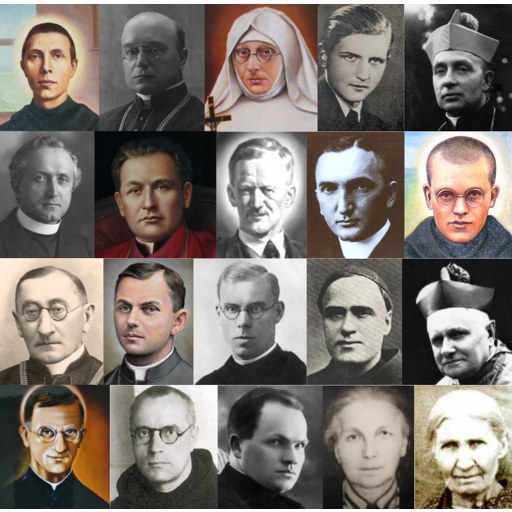
Zbigniew Kotyłło
License: CC BY-SA 4.0
108 Martyrs of World War II
Blessed- Feast Day
- 12 June
- Church
- Catholic
Roles & Family
Canonization
Biography
The 108 Martyrs of World War II, known in Polish as the 108 Błogosławionych Męczenników, are a group of Roman Catholic clergy and lay faithful from Poland killed during the German occupation of 1939–1945. Pope John Paul II beatified them together on 13 June 1999 in Warsaw, during his seventh pilgrimage to Poland. The cause treated them as martyrs put to death in hatred of the faith. As beatified, the group comprises three bishops, fifty-two priests, twenty-six members of male religious congregations, three seminarians, eight women religious, and nine laypeople. They died in concentration camps, prisons, and places of mass execution in occupied Polish territory and in Germany, among them Dachau, Auschwitz, Sachsenhausen, and the camp at Działdowo (Soldau).
From September 1939 the occupying authorities regarded the Polish Catholic Church as a mainstay of national identity and a potential centre of resistance. Clergy were arrested in large numbers, seminaries and religious houses were closed, and in some annexed regions, notably the Reichsgau Wartheland, public church life was reduced almost to nothing. Dachau became the principal internment camp for priests from Poland and from other occupied countries; a high proportion of the Polish clergy imprisoned there did not survive. The 108 were not the only Polish Catholics killed on religious or national grounds, but those for whom a formal process could establish martyrdom according to the norms of the Congregation for the Causes of Saints. Their selection was meant to represent the several states of life in the Church—the episcopate, diocesan priesthood, religious life, and the laity—rather than to list every victim.
The three bishops in the group are Antoni Julian Nowowiejski, bishop of Płock, his auxiliary Leon Wetmański, both of whom died at Soldau in 1941, and Władysław Goral, auxiliary bishop of Lublin, who died at Sachsenhausen. Among the women religious is Alicja Kotowska of the Sisters of the Resurrection, killed in the massacres at Piaśnica in 1939. Other members belonged to dioceses across Poland and to institutes that included the Salesians, Franciscans, and further congregations of men and women. Circumstances of death included shooting, lethal injection, starvation, disease, and the general regime of the camps. Lay members were people who continued catechesis, assisted priests, or would not deny their faith when interrogated. Because the cause was collective, public memory of the 108 is that of a company of witnesses rather than of a single biography.
The beatification Mass was celebrated in Piłsudski Square in Warsaw on 13 June 1999. John Paul II, who had spent the war years in occupied Kraków, presented the new blesseds as models of fidelity for a Church entering a new century. The rite established a collective liturgical cult. The memorial of the 108 Martyrs of World War II is kept on 12 June. They have not been canonized and remain Blessed. Other Polish victims of the same occupation have been beatified in separate processes, both earlier—such as Bishop Michał Kozal in 1987—and later; the 108 therefore form one recognized group among several, not a complete catalogue of Polish Catholic martyrdom in the Second World War. Pilgrimage and local devotion continue in the dioceses from which they came and at former camp and execution sites that have become places of remembrance.