120 martyrs of China is a saint of the Catholic Church. 120 martyrs of China's feast day is celebrated on 9 July.
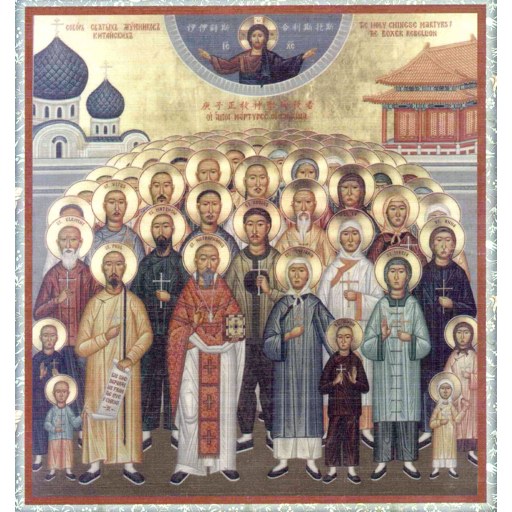
Holy Transfiguration Monastery, Brookline, MA
License: Attribution
120 martyrs of China
Saint- Feast Day
- 9 July
- Church
- Catholic
Places
Roles & Family
Canonization
Biography
The Martyr Saints of China, also known as Saint Augustine Zhao Rong and his 119 companions, are a group of 120 Catholics put to death for their faith in China between 1648 and 1930. Eighty-seven were Chinese—diocesan priests, catechists, and lay men, women, and children—and thirty-three were European missionaries belonging to the Dominicans, Franciscans, Jesuits, Vincentians, Paris Foreign Missions Society, Salesians, and Franciscan Missionaries of Mary, together with other clergy and sisters. They died under the Qing empire and the early Republic, in widely separated missions rather than in a single persecution. Pope John Paul II canonized the whole group on 1 October 2000. Their feast is kept on 9 July, the date in 1900 on which bishops, friars, sisters, and Chinese faithful were executed together at Taiyuan in Shanxi.
Catholic missions that produced these martyrs grew from the late Ming and early Qing periods, especially after Dominicans settled in Fujian. The first of the 120 to die was the Spanish Dominican Francisco Fernández de Capillas, beheaded in Fujian in 1648 and often called the protomartyr of China. Eighteenth-century imperial edicts and local hostility brought further executions of Chinese tertiaries and foreign priests. After the Opium Wars, missions expanded, but Christianity was often linked in popular memory with Western power, and persecution continued. Augustine Zhao Rong, a Chinese soldier who had escorted the arrested Paris Foreign Missions bishop Gabriel-Taurin Dufresse, was converted by the bishop’s example, was baptized and later ordained, and was martyred in 1815; Dufresse himself is among the 120.
The largest cluster of deaths came in 1900 during the Boxer Rebellion, when Yihetuan militias and, in some places, Qing officials attacked missions and Chinese Christian communities. At Taiyuan on 9 July 1900 the Shanxi governor Yu Xian had Bishop Gregorio Grassi, Bishop Francesco Fogolla, several Franciscan friars, seven Franciscan Missionaries of Mary, and Chinese seminarians and lay helpers put to death. Other members of the group were killed the same year in Hunan, Hebei, and elsewhere. Violence did not end with the empire: in 1930 the Salesian bishop Luigi Versiglia and the priest Callisto Caravario were murdered in Guangdong, the last of the 120 to die. Because they perished in many places over nearly three centuries, they share no single tomb; relics and memorials are dispersed among churches in China and in the missionaries’ countries of origin.
Official recognition came in stages. Pope Leo XIII, Pope Pius X, and Pope Pius XII beatified successive clusters of these victims between the 1890s and 1955, grouped by order or by wave of persecution, before John Paul II united all 120 in one canonization. The ceremony fell on the feast of Thérèse of Lisieux, patroness of the missions, and also on the National Day of the People’s Republic of China. Beijing denounced it as a political provocation and associated some of the martyrs with the colonial era; the Holy See presented the honours as religious recognition of Chinese Catholic fidelity. The martyrs remain a focus of devotion among Chinese Catholics in China and in the diaspora. They have no separately defined official patronages beyond their identity as this company of martyrs.