Aaron of Caerleon is a saint of the Catholic Church (d. 304). Aaron of Caerleon's feast day is celebrated on 1 July.
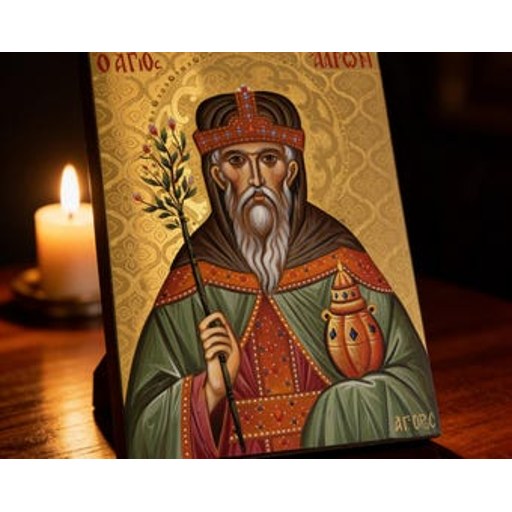
https://etsy.com/listing/815592874/saint-aaron-the-first-priest-orthodox
License: unknown
Aaron of Caerleon
Saint- Life Span
- d. 304
- Feast Day
- 1 July
- Gender
- male
- Church
- Catholic
Places
Roles & Family
Biography
Aaron of Caerleon is one of the few named Christian martyrs of Roman Britain. He is commemorated together with Julius, and both are associated with the legionary fortress of Isca Augusta, later known as Caerleon, in south-east Wales. The earliest surviving notice appears in the De Excidio et Conquestu Britanniae of Gildas, written in the sixth century. Gildas records that Aaron and Julius were put to death at the city of the legions during a persecution in which many other Christians of both sexes also suffered. He gives no precise year. Later tradition has placed the martyrdom in the Great Persecution begun under Diocletian, and martyrologies commonly assign it to about 304.
Bede repeated Gildas’s account in the Ecclesiastical History of the English People in the early eighth century, which carried the names of Aaron and Julius into the wider Latin historical tradition of Britain. In the late twelfth century Gerald of Wales described two churches standing outside the walls of Caerleon, one dedicated to Julius and the other to Aaron, together with a church of Saint Alban. Those dedications show that a local cult was already established by the high Middle Ages. Later writers sometimes presented the pair as Roman soldiers or as prominent citizens of the fortress town, but the earliest sources do not state their rank or occupation.
Nothing reliable is known of Aaron’s birth, family, or life before his death. No contemporary or near-contemporary text records a spouse or children, and he is not associated with any later monastic or clerical order. Although Constantius Chlorus, who governed Britain when Diocletian’s edicts were issued, is generally thought to have enforced them less harshly than his colleagues elsewhere, the survival of the names of Alban, Julius, and Aaron is the principal evidence that executions did take place in the British provinces. The exact site of the execution and of any burial at Caerleon has not been identified.
Western liturgical calendars have generally kept the feast of Saints Julius and Aaron on 1 July, the date under which they appear in the Roman Martyrology. Local Welsh usage has sometimes assigned other nearby days. Their veneration remained chiefly regional, centred on Caerleon and Gwent, though their names were known wherever Gildas and Bede were read. Like other martyrs of the ancient church they were honoured as saints long before papal canonization procedures existed, and no individual pope is recorded as having canonized them. The historical record for Aaron is therefore sparse, resting essentially on the brief notices of Gildas and Bede and on later medieval evidence of church dedications at Caerleon.