Aaron is a saint of the Catholic Church.
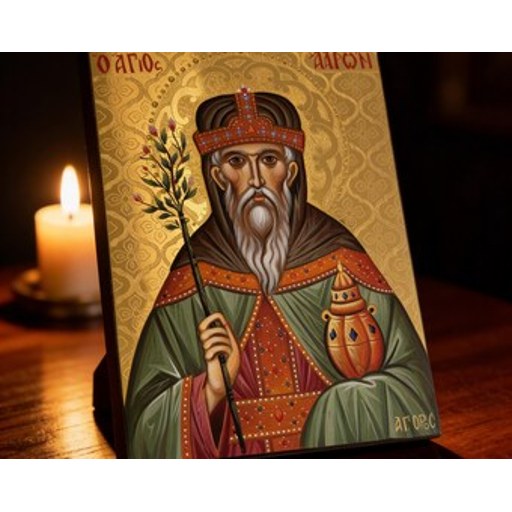
https://etsy.com/listing/1097528281/saint-aaron-icon-st-aaron-the-first-high?lang_mismatch=1
License: unknown
Aaron
Saint- Gender
- male
- Church
- Catholic
Places
Roles & Family
Religious Information
Biography
Aaron is the elder brother of Moses and Miriam in the Hebrew Bible and the first high priest of Israel in the priestly traditions of Exodus, Leviticus, and Numbers. He is presented as a Levite, a son of Amram and Jochebed. The narrative setting of his birth is Egypt during the bondage of the Israelites. Exodus 7:7 states that he was eighty-three when he and Moses first appeared before Pharaoh, three years older than Moses, and Numbers 33:39 states that he was one hundred twenty-three at his death. No historically verified civil year of birth or death can be established. Historians and archaeologists do not agree on whether Aaron was a single individual of the late second millennium BCE or a figure shaped by later priestly memory; the biblical books remain the primary sources for his story.
In the Exodus account Aaron serves as Moses' spokesman after Moses protests that he is not eloquent. Aaron's staff is central to several signs before Pharaoh: it becomes a serpent and swallows the staffs of the Egyptian magicians, and it is associated with some of the plagues. After the departure from Egypt and the covenant at Sinai, Aaron and his sons Nadab, Abihu, Eleazar, and Ithamar were consecrated to the priesthood, with Aaron as high priest, wearing the ephod, breastpiece, and other vestments described in Exodus 28. Exodus 6:23 records that he married Elisheba, daughter of Amminadab and sister of Nahshon of Judah. The same tradition reports that Nadab and Abihu died after offering unauthorized fire before the Lord (Leviticus 10). While Moses remained on the mountain, Aaron yielded to the people's demand and fashioned the golden calf (Exodus 32), an episode that later Jewish and Christian interpreters have explained in various ways, sometimes mitigating Aaron's responsibility and sometimes treating it as a grave failure of leadership.
Numbers continues Aaron's story in the wilderness. He and Miriam spoke against Moses on account of the Cushite woman Moses had married, and Miriam was struck with a skin disease while Aaron pleaded for her (Numbers 12). In the rebellion of Korah, Dathan, and Abiram, the exclusive claim of Aaron's line to the priesthood was challenged; the narrative concludes with the earth swallowing the rebels and with Aaron's rod budding and producing almonds as a sign that his house was chosen (Numbers 16–17). At Meribah, Moses and Aaron were told they would not enter the land of Canaan because they did not sanctify the Lord before the people when water was brought from the rock (Numbers 20). According to Numbers 20:22–29, the Israelites came to Mount Hor, on the boundary of Edom, where Moses, at divine command, stripped Aaron of his garments and put them on Eleazar; Aaron died there and was mourned thirty days. Deuteronomy 10:6 preserves a related notice locating a death and burial tradition at Moserah. The mountain later identified in local tradition as Aaron's tomb is Jabal Harun near Petra, though that identification is traditional rather than archaeologically demonstrated.
In subsequent Jewish tradition Aaron became the model of the priesthood and was remembered as a lover of peace, as in the saying attributed to Hillel in Pirkei Avot that one should be a disciple of Aaron, loving peace and pursuing peace. Rabbinic literature elaborates many episodes of his life. Christian churches have numbered him among the righteous of the Old Covenant; Eastern Christian synaxaria include commemorations of the holy prophet and high priest Aaron, though the date of observance is not uniform across jurisdictions, and he does not occupy a prominent place in the General Roman Calendar of the Latin Church. In Islam he is known as Harun, a prophet and the brother of Musa, mentioned in the Quran as assisting Moses and as a figure of priestly and prophetic dignity. Because the sources are religious narratives compiled and edited over a long period, a cautious historical account must distinguish the richly attested traditional portrait from any claim to a precisely dated secular biography.