Abbot Benedict is a saint of the Catholic Church. Abbot Benedict's feast day is celebrated on 11 July. Abbot Benedict is the patron saint of Europe;monks;nuns;students;schoolchildren;against poison;farmers;speleologists;dying people;Norcia;architects.
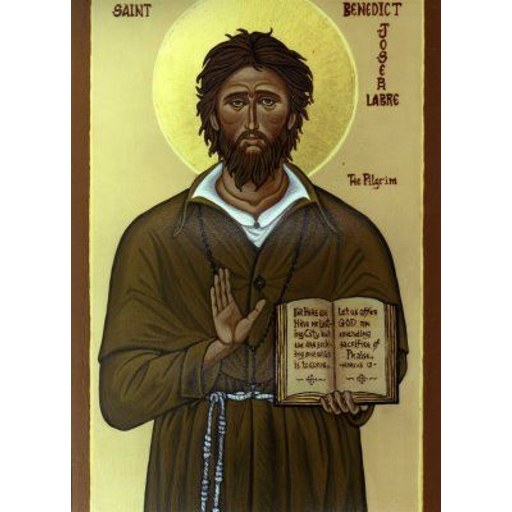
https://www.pinterest.com/ideas/st-benedict-icon/916523440253/
License: unknown
Abbot Benedict
Saint- Feast Day
- 11 July
- Gender
- male
- Church
- Catholic
Places
Roles & Family
Religious Information
Patronage
Europe;monks;nuns;students;schoolchildren;against poison;farmers;speleologists;dying people;Norcia;architects
Biography
The figure commonly meant by Abbot Benedict is Saint Benedict of Nursia, the Italian monk of the early sixth century whose Rule became the principal legislative text of Latin monasticism. Almost everything that can be said of his life depends on Book II of the Dialogues of Pope Gregory the Great, written about 593, a generation after Benedict’s death. Gregory describes him as a man of respectable family from Nursia (modern Norcia) in Umbria, sent as a youth to Rome for literary studies. Disturbed by the moral disorder of the city, he abandoned that career, lived for a time at Enfide (Affile), and then withdrew to a cave in the gorge of the Anio at Subiaco. There he spent about three years as a hermit, clothed in skins and fed by the monk Romanus, until local shepherds found him and his reputation for holiness began to draw disciples.
Those disciples were organized into twelve small monasteries of twelve monks each around Subiaco, with Benedict exercising overall care from a thirteenth house. Gregory reports hostility from a local priest, including an attempt to poison Benedict—a cup said to have shattered when he blessed it, and a loaf carried off by a raven at his command. Benedict then left Subiaco and founded a monastery on the height of Monte Cassino, between Rome and Naples, replacing a lingering pagan cult of Apollo with oratories of Saint Martin and Saint John the Baptist. It was there that he wrote the Rule that bears his name. The Rule is moderate by comparison with many earlier Eastern and Western codes: it binds the monk to stability, obedience, and conversatio morum under an abbot conceived as a father and steward, and it structures the day around the Divine Office, sacred reading, and manual work.
Gregory’s narrative is largely a catalogue of miracles and spiritual discernment: a lost bill-hook recovered from a lake, a young monk raised after a collapsing wall, prophetic knowledge of distant events and of the future destruction of Monte Cassino, and a vision in which the whole world appeared gathered as in a single ray of light. Benedict’s sister Scholastica, a consecrated virgin, met him once a year; at their last meeting her prayer brought a storm that kept him from returning to the monastery so that they might continue speaking of God. He is said to have died shortly afterward, standing in prayer with his arms supported by his monks, and to have been buried in the oratory of Saint John at Monte Cassino in the same tomb as Scholastica. Later centuries disputed the relics between Monte Cassino and the abbey of Fleury (Saint-Benoît-sur-Loire).
Gregory gives no years. Later tradition commonly places Benedict’s birth about 480 and his death on 21 March in the 540s, dates that are calculated rather than documented and that vary in the sources (often 543 or 547). Monte Cassino was destroyed by the Lombards around 577. The Rule spread through Gaul, England, and the Germanic lands and became normative in the Carolingian world especially through the reforming work of Benedict of Aniane in the early ninth century. In the Roman calendar the feast is now 11 July, associated with a translation of relics; 21 March was the older date of death. Pope Paul VI declared Benedict Patron of Europe in 1964. The sources present him as a monk from youth and record neither wife nor children. Veneration is ancient and pre-congregation; there was no modern-style papal canonization.