Abbot Menelaus is a saint of the Catholic Church. Abbot Menelaus's feast day is celebrated on 18 July.
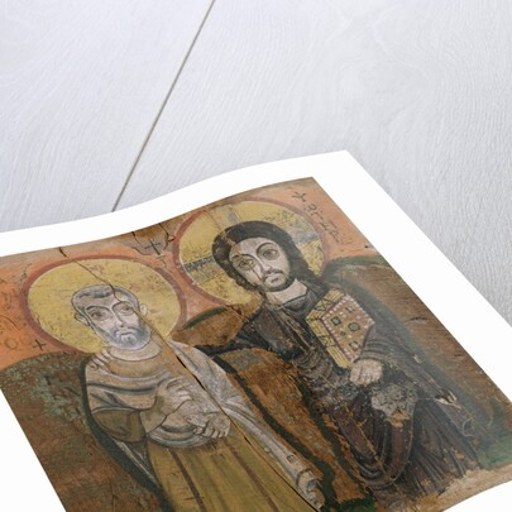
https://www.magnoliabox.com/products/icon-depicting-abbott-mena-with-christ-xir50882
License: unknown
Abbot Menelaus
Saint- Feast Day
- 18 July
- Gender
- male
- Church
- Catholic
Places
Roles & Family
Biography
Abbot Menelaus, whose name appears in French sources as Ménelé, Ménelée, or Meneleus, was a monastic superior of the later Merovingian age, remembered as the restorer and abbot of the monastery of Menat in Auvergne. He belongs to that large class of Frankish holy men whose lives were written down only after a considerable lapse of time and whose historical outlines are therefore difficult to recover with precision. Modern notices place him in the seventh century or the opening decades of the eighth. No contemporary charter, letter, or chronicle mentions him by name, and the principal accounts derive from later liturgical calendars, from the traditions of Menat Abbey itself, and from compilations such as the Acta Sanctorum. He is nonetheless commemorated as a saint in local and some general calendars of the Western Church.
The received legend states that Menelaus was a native of Anjou, the ancient territory of the Andecavi in western Gaul, and that he was born into a family of wealth and rank. In early adulthood he is said to have given away his property to the poor and to have sought admission to the monastery of Saint-Jouin-de-Marnes in Poitou, a house dedicated to Saint Jovinus and already an established centre of monastic life. After a period of formation there, he left for the mountainous country of Auvergne. Local tradition linked the site of Menat, on the river Sioule in what is now the département of Puy-de-Dôme, with an earlier foundation attributed to Saint Calminius (Calmin) and his wife Namadia, aristocratic founders whose own dates are likewise uncertain. Menelaus is credited with gathering or reconstituting a community at Menat and with governing it as abbot.
In the hagiographical portrait he appears as a diligent abbot who combined personal austerity with care for the monks and for the rural population around the monastery. Concrete episodes, miracles, or datable administrative acts are not preserved in early independent sources. His death is assigned by later writers to 18 July; a year in the neighbourhood of 720 is sometimes supplied in secondary compilations, but it rests on convention rather than on a documented obituary. He was buried at Menat, and the abbey church remained the focus of his cult through the Middle Ages. In subsequent centuries the community of Menat adopted the Rule of Saint Benedict and was numbered among the Benedictine houses of the region; whether Menelaus himself already followed that Rule cannot be demonstrated from surviving evidence.
The cult of Abbot Menelaus remained essentially local. He is entered in some martyrologies and diocesan calendars on 18 July, though certain French popular listings give 22 July. He was not the object of a formal canonization process of the type that developed in the later Middle Ages; his status as a saint rests on ancient popular and monastic veneration. No writings are attributed to him. He is not recorded as having been married, and the monastic state in which tradition places him from early adulthood implies celibacy; no children are mentioned in any of the accounts. He never occupied the see of Rome or any patriarchal throne. Specific patronages of places, trades, illnesses, or causes are not securely attached to his name in the standard repertoires of hagiography. The historian must therefore treat him as a poorly documented but genuine figure of Frankish monasticism, whose memory was preserved by the abbey he is said to have restored.