Abbot Robert is a saint of the Catholic Church.
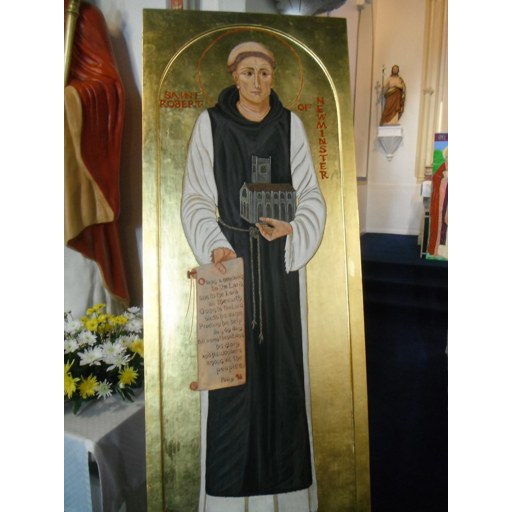
https://strobertsmorpeth.com/history/st-robert-of-newminster-icon-a-work-in-progress
License: unknown
Abbot Robert
Saint- Gender
- male
- Church
- Catholic
Roles & Family
Biography
The designation Abbot Robert does not identify a single, uniquely attested historical person. Robert was among the most common masculine baptismal names in medieval Latin Christendom, and the office of abbot was held by a great many men of that name in Benedictine, Cistercian, Cluniac, and other communities from the early Middle Ages through the later medieval period. No Wikidata identifier, Wikipedia article, toponym, century, or religious house was supplied with the request. Under those conditions it is not possible to assign a verified year of birth or death, a birthplace, a place of death, a burial site, a feast, a patronage, or a canonization or beatification to one individual without substituting another man’s vita. Office-taking years, foundation dates, and the biographies of better-known namesakes are therefore omitted rather than used as proxies.
Several well-documented abbots named Robert appear in chronicles and liturgical calendars, and they must not be conflated. Saint Robert of Molesme, a Burgundian monastic reformer of the late eleventh and early twelfth centuries, is remembered as a founder of Cîteaux and of the Cistercian observance; he died in 1111 and has a distinct cult. Saint Robert of Newminster, an English Cistercian of the twelfth century, was abbot of Newminster in Northumberland and died in 1159. Robert of Jumièges was a Norman abbot of the eleventh century who later became archbishop of Canterbury. Robert of Torigni was abbot of Mont-Saint-Michel in the twelfth century and a noted chronicler. Other Roberts governed houses at Chaise-Dieu, at various English and French Benedictine abbeys, and elsewhere. Each of these men has his own dates, order, and, where relevant, liturgical memory. None of them can be treated as the default referent of the bare title Abbot Robert.
Because the subject remains unspecified, fields that require a single documented life are left empty. Gender is recorded as male solely from the given name Robert and the masculine office of abbot (as distinct from abbess). There is no evidence in the request that this person was Bishop of Rome or Coptic Pope of Alexandria, nor Patriarch or Catholicos of an Eastern see; those offices are therefore marked no. Marital status, children, religious order, and cultic details cannot be filled from a generic monastic title: while Latin abbots were ordinarily professed celibates, that is a rule of many institutes, not a verified fact about an unnamed Robert, and some earlier or irregular cases would require source-by-source proof. Patronage lists and feast days belong to particular saints, not to the name as such.
Hagiographical writing has often merged homonymous abbots, assigned legendary childhoods, or treated the year a man entered office as if it were a birth year. The present record refuses those habits. If a later identification supplies a house, a reliable vita, or a calendar entry tied to one Robert, the empty fields can be completed from that evidence. Until then, honesty about the limits of the name is the historically responsible account.