Abdas of Susa is a saint of the Catholic Church (d. 420). Abdas of Susa's feast day is celebrated on 16 May.
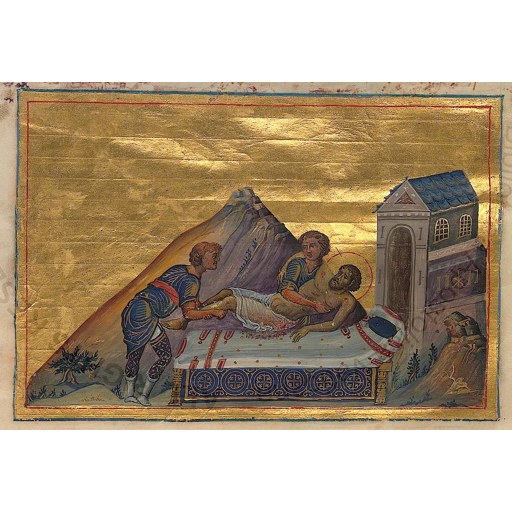
Authors of Menologion of Basil II (circa 985 AC, Constantinople), Byzantine manuscript illuminators[1]: Pantoleon with Georgios, Michael the Younger, Michael of Blachernae, Symeon, Symeon of Blachernae, Menas, and Nestor (Online on Vatican site)
License: Public domain
Abdas of Susa
Saint- Life Span
- d. 420
- Feast Day
- 16 May
- Gender
- male
- Church
- Catholic
Places
Roles & Family
Biography
Abdas of Susa, also known in the sources as Abda, Abdias, or Audas, was a Christian bishop of the early fifth century in the Sasanian Empire. He is identified as bishop of Hormizd-Ardashir, a see in Khuzestan commonly associated in later tradition with the ancient city of Susa in southwestern Persia (present-day Iran). Almost nothing can be verified about his family, education, or the date and place of his birth. Later hagiographical notices sometimes locate his origins in fourth-century Chaldea, in southern Mesopotamia, but this is not confirmed by contemporary evidence and no year of birth is known. He belonged to the Persian Church (the Church of the East) during the reign of Yazdegerd I (399–420), a period that had begun with relative royal tolerance toward Christians after the severe persecutions of the fourth century under Shapur II.
Abdas is remembered above all for a single episode that ended that uneasy peace. According to the fifth-century church historian Theodoret of Cyrrhus, the bishop destroyed a Zoroastrian fire temple. Yazdegerd I, whose own religious policy had previously been comparatively moderate, ordered Abdas to restore the sanctuary. Abdas refused, holding that to rebuild a fire temple would be an act of apostasy incompatible with Christian faith. The king then had him put to death. The execution is conventionally dated to 420, at the close of Yazdegerd’s reign. Independent confirmation of every narrative detail is lacking, and later martyrologies may have heightened the drama, but the core of the story—destruction of a fire temple, royal demand for restitution, refusal, and execution—is attested in Greek ecclesiastical historiography of the same century and is echoed in later Oriental Christian chronicles.
The killing of Abdas is widely treated by ancient and modern historians as the immediate occasion for a renewed persecution of Christians across the Sasanian realm. After Yazdegerd’s death in 420, his successor Bahram V continued and intensified measures against the Church: churches were demolished, clergy and laypeople were imprisoned or executed, and many Christians fled westward into Roman territory. The episode thus stands at the beginning of one of the major fifth-century crises of the Church of the East. Abdas himself held only a diocesan bishopric; he was not catholicos-patriarch of Seleucia-Ctesiphon, nor did he hold any office comparable to the papacy. No reliable source records a spouse, children, or membership in a monastic order.
Veneration of Abdas as a martyr-bishop took root in both Eastern and Western calendars. The Roman Martyrology commemorates him on 16 May. He belongs to the large company of early saints whose cult arose by popular and liturgical acclaim long before the later medieval processes of papal canonization and beatification, and no individual pope or patriarch is recorded as having formally canonized him. Beyond his role as a martyr of the Persian Church, no historically attested patronages of places, professions, or causes can be verified.