Abercius of Hieropolis is a saint of the Catholic Church. Abercius of Hieropolis's feast day is celebrated on 22 October.
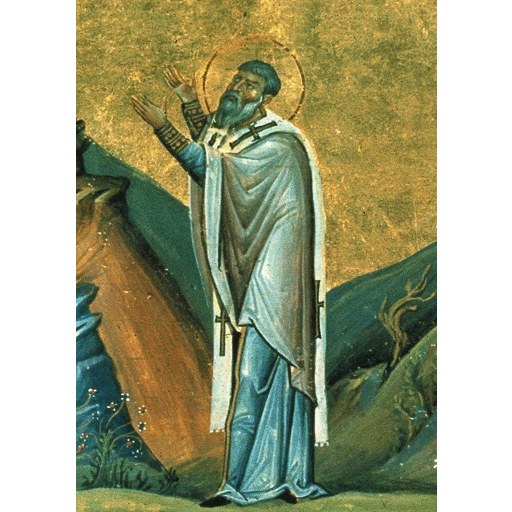
Authors of Menologion of Basil II (circa 985 AC, Constantinople), Byzantine manuscript illuminators[1]: Pantoleon with Georgios, Michael the Younger, Michael of Blachernae, Symeon, Symeon of Blachernae, Menas, and Nestor (Online on Vatican site)
License: Public domain
Abercius of Hieropolis
Saint- Feast Day
- 22 October
- Gender
- male
- Church
- Catholic
Places
Roles & Family
Biography
Abercius of Hieropolis (also Aberkios, and often called Abercius of Hierapolis) was a Christian bishop of Hieropolis in Phrygia Salutaris, in western Asia Minor, during the second century of the Roman Empire. He is among the earliest named bishops of interior Anatolia whose memory rests on both an almost contemporary inscription and later liturgical tradition. His see belonged to the Phrygian Pentapolis and is distinct from the better-known Hierapolis of Phrygia (modern Pamukkale). No reliable source records his parentage, birthplace, or the year of his birth. He was neither pope nor patriarch; his office was that of an ordinary local bishop in a modest Phrygian city.
His historical importance depends above all on the Epitaph of Abercius, a Greek metrical funerary inscription that is one of the oldest surviving extra-biblical Christian inscriptions. Substantial fragments, recovered in the late nineteenth century near Hieropolis and now in the Vatican Museums, present the text as Abercius’s own tomb monument. Speaking in the first person, he calls himself a disciple of a holy shepherd who taught him faithful writings, describes a journey to Rome where he saw a queen in golden robes and golden shoes, and records travel through Syria as far as Nisibis beyond the Euphrates, finding brethren everywhere. The wording is deliberately veiled: the fish as a sign of Christ, bread and mixed wine as the Eucharist, and the queen as the Church. He states that he had the epitaph prepared at the age of seventy-two and forbids any other burial in his tomb, with a fine payable to the Roman fisc and to the city of Hieropolis. Paleography and internal allusions lead most historians to place the stone in the later second century, but they do not yield a precise year of death.
A much fuller story appears in the Greek Life of Abercius, a hagiographical narrative generally dated to the fourth century or later. There Abercius is bishop in the reign of Marcus Aurelius, destroys idols at Hieropolis, is summoned to Rome to exorcise an imperial princess, and undertakes wide missionary journeys in the East. These episodes are not confirmed by independent second-century evidence and are treated by modern historians as largely legendary, though they may preserve a memory of a well-traveled Phrygian churchman. Some scholars have proposed identifying the Abercius of the epitaph with Avircius Marcellus, a prominent Phrygian Christian named by Eusebius of Caesarea in connection with an anti-Montanist writing; the identification is chronologically and geographically plausible but remains unproven. Traditional martyrologies sometimes give a death date around 167, tied to the legendary association with Marcus Aurelius; that figure is not independently verified, and the inscription itself is often dated somewhat later.
Abercius is venerated as a saint in the Eastern Orthodox Church and in the Roman Catholic Church, with his feast on 22 October. In the East he is sometimes styled Equal-to-the-Apostles and wonderworker, titles that reflect the missionary portrait of the later vita rather than the restrained self-presentation of the epitaph. Nothing reliable is known of a spouse, children, or membership in any later religious order, which did not yet exist in his lifetime. His burial is implied by the epitaph itself to have been at Hieropolis in Phrygia. The inscription remains the principal, and the only nearly contemporary, document of his life.