Abo of Tiflis is a saint of the Catholic Church (d. 786). Abo of Tiflis's feast day is celebrated on January 8. Abo of Tiflis is the patron saint of Tbilisi.
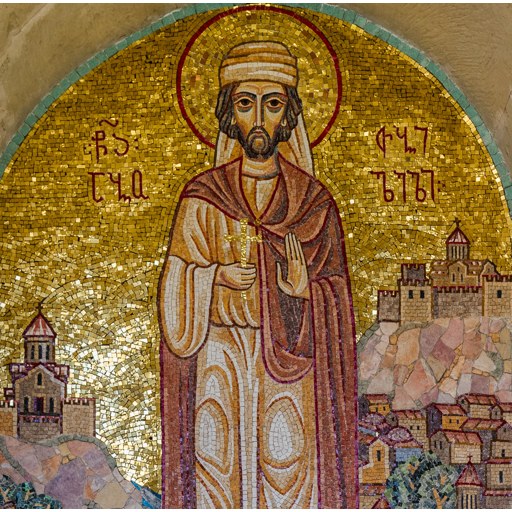
Diego Delso
License: CC BY-SA 4.0
Abo of Tiflis
Saint- Life Span
- d. 786
- Feast Day
- January 8
- Gender
- male
- Church
- Catholic
Places
Roles & Family
Patronage
Tbilisi
Biography
Abo of Tiflis, also known as Abo of Tbilisi or Abo Tbileli, was an eighth-century Christian martyr of Arab origin who became the patron saint of Tbilisi in Georgia. According to his near-contemporary Passion, written by the Georgian cleric Ioane Sabanisdze, Abo was a native of Baghdad in the Abbasid Caliphate and was raised in a Muslim family. He worked as a perfumer, preparing fragrant oils and unguents. In the later eighth century he entered the circle of Nerses, the erismtavari (ruling prince) of Kartli, who had been detained at the caliphal court and was later allowed to return to the Caucasus. Abo accompanied Nerses on that journey and thus came to live among the Christian population of eastern Georgia.
In Kartli, Abo was drawn to Christianity by the example and teaching of the Georgians. Because Tbilisi and much of Kartli then lay under Arab political authority, an open conversion in the capital was dangerous. He therefore went with Nerses into Abkhazia in western Georgia, a region then more independent of caliphal control. There he received baptism, learned Georgian, and took up a life of prayer, fasting, and study of the Christian scriptures. After a period in the west he resolved to return to Tbilisi in order to confess Christ publicly in a city still governed by Muslim officials.
On his return he was denounced as an apostate from Islam. The Arab emir of Tbilisi had him arrested and imprisoned, offering inducements and threats to make him recant. Abo refused, insisting that he had freely chosen the Christian faith. Contemporary narrative describes a spell of imprisonment during which local Christians visited him and he received the Eucharist, followed by a brief interval of relative freedom in the city during which he continued to profess Christianity openly before he was seized again.
He was beheaded in Tbilisi on 6 January 786, a date associated in the sources with the feast of Theophany. To prevent the collection of relics, the authorities burned his body and scattered the ashes in the Mtkvari (Kura) River. Ioane Sabanisdze, writing shortly afterward at the request of Catholicos Samoel of Kartli, recorded these events in the Martyrdom of Abo, an important early work of Georgian hagiography. The Georgian Church commemorated him as a martyr; his feast is kept on 8 January. He is venerated as the patron saint of Tbilisi, and a church dedicated to him stands near the Metekhi cliff above the river into which his ashes were cast.