Abraham de Georgiis is a venerable of the Catholic Church.
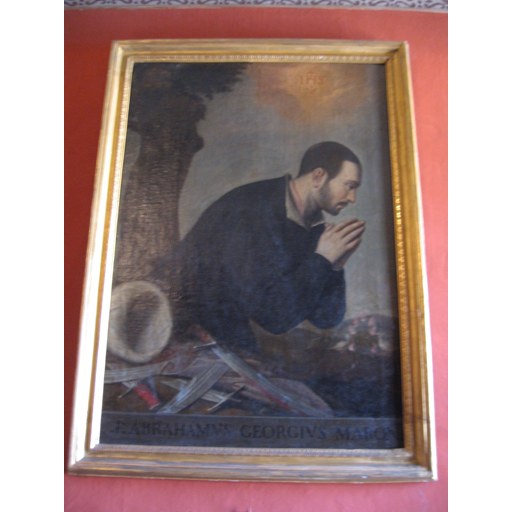
Grentidez
License: CC0
Abraham de Georgiis
Venerable- Gender
- male
- Church
- Catholic
Places
Roles & Family
Religious Information
Biography
Abraham de Georgiis was a Georgian Catholic priest of the Theatine order (Clerics Regular) who lived in the later sixteenth and earlier seventeenth centuries. He is known from the history of the Latin missions to the Caucasus rather than from any full contemporary biography. Born in Georgia, he went to Italy, entered the Congregation of Clerics Regular, and was ordained in the Latin Church. His native language and his familiarity with Georgian Christianity made him unusually useful to a Roman missionary effort that otherwise depended on Italian clergy. The Latin form of his name, de Georgiis, is the designation used in Italian and missionary sources for a Georgian member of the order.
In the 1620s the Holy See, working through the recently founded Congregation for the Propagation of the Faith and with the Theatine congregation, organized a mission to the Georgian kingdoms. Those kingdoms—Kartli, Kakheti, Imereti, and the western principalities—were then under severe pressure from both the Ottoman Empire and Safavid Persia, and local rulers shifted allegiance amid almost continuous warfare. Abraham de Georgiis was sent back to his homeland as a member of that mission and served alongside Italian Theatines. Missionary correspondence presents him as a preacher and as a mediator between Latin clergy and local society in a setting often hostile to the Latin rite.
Later Catholic and Theatine tradition has described him as having died for the faith at the hands of Muslim authorities during the disorders that afflicted Georgia in the first half of the seventeenth century. The exact year, place, and circumstances of his death are not established with certainty in sources that can be verified here. He does not appear to have been formally beatified or canonized, and no feast day or recognized patronage is attached to his name in the general calendars of the Catholic Church. As a professed Theatine he lived under the vows of the clerks regular, including celibacy.
Because the surviving notices are brief and often second-hand, many elementary facts remain unknown: the city of his birth, the year of his birth, the house in which he made religious profession, and the precise manner of his death. He belongs to a small group of Georgian-born Catholic religious who, in the early modern period, tried to bind their country to Rome and who worked in a region contested by Islamic empires. His life is of interest to the history of the Theatine missions and of Georgian Catholicism, even though it cannot be reconstructed in the detail that a fuller archival study might one day provide.