Achatius of Armenia is a saint of the Catholic Church. Achatius of Armenia's feast day is celebrated on 22 June. Achatius of Armenia is the patron saint of headaches;fear of death;soldiers.
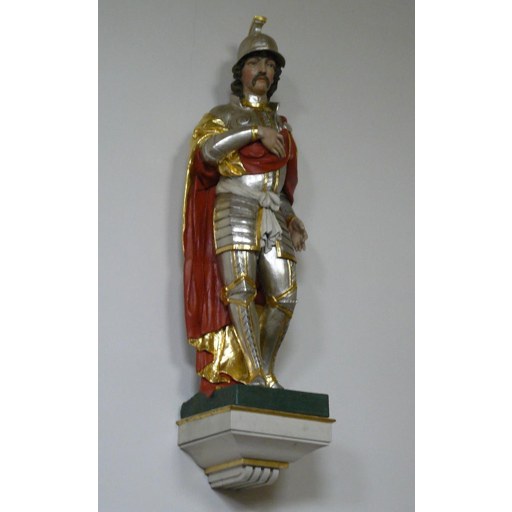
Schuppi
License: CC BY-SA 3.0
Achatius of Armenia
Saint- Feast Day
- 22 June
- Gender
- male
- Church
- Catholic
Places
Roles & Family
Patronage
headaches;fear of death;soldiers
Biography
Achatius of Armenia (also known as Acacius, Agathius, or Achaz) is venerated in the Western Church as a martyr and as one of the Fourteen Holy Helpers, a group of saints whose collective cult flourished in the late medieval Holy Roman Empire. No contemporary historical documentation confirms his life, and modern hagiographical scholarship treats the narratives attached to his name as legendary. The epithet “of Armenia” derives from the traditional setting of his martyrdom rather than from any verified biographical origin. In medieval Latin and later vernacular passiones he appears as a Roman army officer, often a centurion, who converted to Christianity together with a great number of soldiers—conventionally ten thousand—and was put to death for the faith on Mount Ararat.
The legend of the Ten Thousand Martyrs, with which Achatius is identified in Western devotion, circulated in various recensions from the Middle Ages. In the usual form, the soldiers, campaigning in the East, were converted by a miraculous intervention or by Christian preaching, refused to offer pagan sacrifice, and were crucified en masse. Some versions place the event in the reign of the emperor Hadrian in the early second century; others associate it with later imperial persecutions. A distinct earlier cult of Agathius (Acacius) of Byzantium, a Cappadocian centurion said to have been martyred at Byzantium at the beginning of the fourth century and commemorated in May, was frequently fused with the Armenian mass-martyrdom story in Central European piety, so that attributes of both figures appear under the single name Achatius. Eastern calendars preserve related commemorations of soldier-martyrs, but they do not yield an independent, historically controlled biography of this Achatius.
From the fourteenth century the cult of Achatius gained particular importance in German-speaking lands as part of the devotion to the Fourteen Holy Helpers (Vierzehn Nothelfer), popularized in the wake of plague and other calamities and associated with shrines such as Vierzehnheiligen in Franconia. Within that group Achatius was invoked especially against headaches and, in some local traditions, against the fear of death or for aid in the dying hour. His liturgical feast in the West is 22 June, the day on which the Roman Martyrology commemorates the ten thousand martyrs of Mount Ararat. He is customarily represented in art as an armed knight or centurion, sometimes wearing a crown of thorns or holding a branch of thorns, and often accompanied by a host of crucified companions or a military banner. Churches, altars, and relics dedicated to him are attested across southern Germany, Austria, and adjacent regions.
Because the underlying texts are late and legendary, a careful historian cannot assign a verified year of birth or death, a native city, or details of family life. Achatius was not a bishop of Rome, a patriarch, or a member of a religious order; the tradition presents him as a soldier-martyr. His historical significance lies less in recoverable second- or fourth-century events than in the well-documented late-medieval and early-modern cult that made him a familiar intercessor in Catholic Central Europe. Critical study continues to distinguish him from other saints of similar name, including Acacius of Melitene, a fifth-century bishop of Armenia Minor, and Acacius of Constantinople, a fourth-century patriarch, neither of whom is the figure intended by the title Achatius of Armenia in Western popular hagiography.