Acisclus is a saint of the Catholic Church (d. 304). Acisclus's feast day is celebrated on 17 November. Acisclus is the patron saint of Córdoba, Spain.
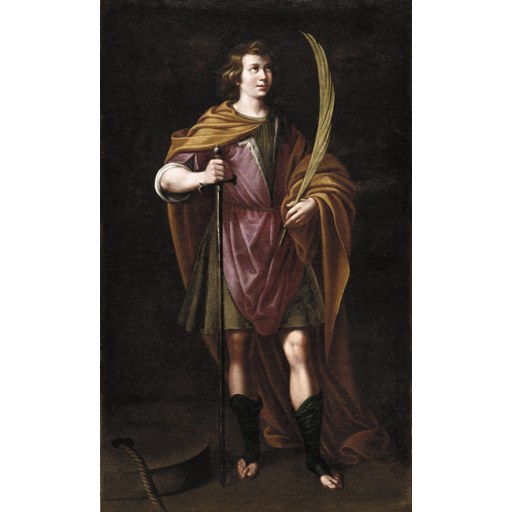
José de Sarabia
License: Public domain
Acisclus
Saint- Life Span
- d. 304
- Feast Day
- 17 November
- Gender
- male
- Church
- Catholic
Places
Roles & Family
Patronage
Córdoba, Spain
Biography
Acisclus, known in Spanish as Acisclo and in Catalan as Aciscle, was a Christian martyr of Córdoba (ancient Corduba) in the Roman province of Hispania Baetica. He is counted among the victims of the persecution of Christians under the emperor Diocletian, and later calendars and martyrologies place his death in 304. He is commemorated together with Victoria, whom medieval tradition identifies as his sister. No contemporary administrative record of his trial survives, and his age, family background, and station in life are not documented by sources close to the events. What can be said with confidence is that a martyr named Acisclus was honored at Córdoba by the late fourth century and that his cult became one of the defining Christian memories of the city.
The earliest literary witness is the Hispanic Christian poet Prudentius, who in the Peristephanon, composed around the year 400, lists Acisclus among the martyrs whom Córdoba contributes to the roll of the Spanish saints, naming him alongside Zoellus (Zoilus). That notice shows that the cult was already public and geographically identified within a century of the traditional date of the martyrdom. The Hieronymian Martyrology and, later, the Roman Martyrology record Acisclus and Victoria on 17 November at Córdoba, under a persecuting governor named Dion in the time of Diocletian. A Latin passio, written considerably later than Prudentius and marked by the conventional episodes of Iberian martyr legends, supplied the Middle Ages with a connected story of arrest, interrogation, torture, miracle, and execution. Modern historians regard that passio as a hagiographical composition rather than a transcript of official acts, and they note that Victoria does not appear in Prudentius’s brief Cordoban list, so the sibling pairing, however ancient in liturgy, cannot be verified from the earliest witness.
In the legendary passio, Acisclus and Victoria are young Christians of Córdoba who refuse to offer sacrifice to the gods. Brought before the governor Dion, they confess Christ and undergo a succession of torments: they are said to have been exposed to fire, cast into the river Baetis (the Guadalquivir) with weights, and subjected to further cruelties, remaining unharmed until the authorities finally put them to death, Acisclus typically by beheading. The narrative presents them as virgins as well as martyrs. None of these narrative details can be corroborated outside the passio and texts dependent on it, but they determined how the saints were depicted in Mozarabic and later medieval liturgy, in sermons, and in art, and they explain why the pair entered the tradition as brother-and-sister virgin martyrs of Córdoba.
Devotion to Acisclus was embodied in a basilica at Córdoba that is attested in the Visigothic period and that continued as a church of the Mozarabic Christian community after the Islamic conquest of the city in the eighth century. Medieval writers mention the church of San Acisclo as a landmark of Christian Córdoba. Relics attributed to Acisclus and Victoria were kept there and in time were shared with other churches in the Iberian Peninsula, which extended the cult beyond the city. Acisclus and Victoria came to be honored as patron saints of Córdoba; their feast on 17 November was observed in the Mozarabic rite and was received into the Roman Martyrology, securing a place in the wider Latin calendar. Although the reconstructed biography remains largely traditional, the combination of Prudentius’s testimony, an early local basilica, and continuous liturgical commemoration establishes Acisclus as a genuine figure of the early Cordoban church whose memory was central to Christian identity in that city from late antiquity through the Middle Ages.