Adalbert of Egmond is a saint of the Catholic Church (d. 710). Adalbert of Egmond's feast day is celebrated on 25 June. Adalbert of Egmond is the patron saint of Egmond.
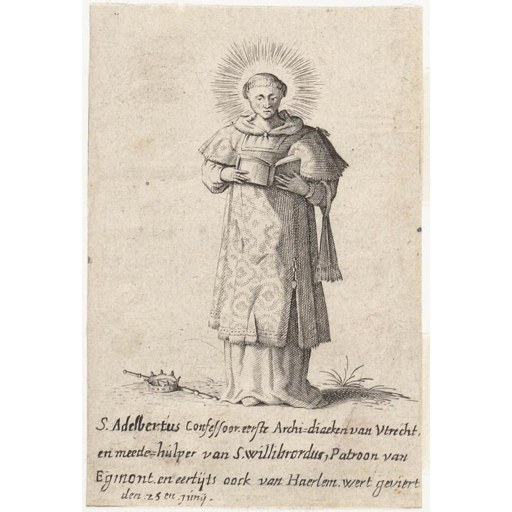
Unknown authorUnknown author
License: Public domain
Adalbert of Egmond
Saint- Life Span
- d. 710
- Feast Day
- 25 June
- Gender
- male
- Church
- Catholic
Places
Relics & Where to Venerate
Location unknown
The bodily remains of Adalbert of Egmond are a first-class relic. Venerated at Egmond Abbey.
Roles & Family
Patronage
Egmond
Biography
Adalbert of Egmond (also called Adelbert or Adelbertus) was a Northumbrian Anglo-Saxon missionary who laboured in Frisia at the turn of the seventh and eighth centuries. Almost nothing about his early life can be verified from contemporary documents. A Latin life composed at Egmond in the late tenth century, more than two centuries after his death, presents him as a man of noble Northumbrian birth who entered the monastic life and was formed at Rath Melsigi in Ireland, a house well known as a training ground for English monks destined for the continental missions. From that circle he attached himself to Willibrord, the Northumbrian who in the 690s received a papal commission to preach among the Frisians and who became archbishop of Utrecht.
As one of Willibrord’s companions, Adalbert took part in the difficult work of converting a region still largely pagan and politically unstable, caught between Frankish power and Frisian resistance. Later tradition places his particular field of work in Kennemerland, the coastal district of what is now North Holland, and especially at Egmond. He is remembered as a preacher and priest rather than as a diocesan bishop; some medieval writers style him an archdeacon of Willibrord, but that title is not confirmed by early evidence. Eighth-century sources that describe Willibrord’s mission do not name Adalbert individually, so the reconstruction of his ministry rests on the Egmond cult and on the tenth-century vita, which must be used with caution.
According to the tradition of his shrine, Adalbert died at Egmond on 25 June in the early eighth century, a date often given as about 710. He was buried locally, and a wooden church came to mark the site. Reports of miracles at the tomb attracted pilgrims. In the tenth century the counts of Holland, above all Dirk II, took up the cult as part of their dynastic and territorial identity. Adalbert’s relics were solemnly translated, and a monastery was established at Egmond in his honour. That house, the Abbey of Egmond, became the leading Benedictine abbey of the county, a centre of historical writing, and the burial place of the Holland dynasty. A well near the abbey, the Adelbertusput, was associated with the saint.
Adalbert’s feast is celebrated on 25 June. He is the patron saint of Egmond and was long regarded as a heavenly protector of the County of Holland. His veneration remained essentially regional and was closely tied to the abbey. When the monastery was destroyed during the Dutch Revolt in the late sixteenth century, the relics were scattered or lost, yet local memory of the saint persisted, and the well and later restorations of religious life at Egmond kept his name alive. Modern historians accept him as a genuine figure of Willibrord’s Anglo-Saxon mission while treating the legendary details of the tenth-century life as evidence for medieval devotion rather than as a contemporary biography.