Adrian and Natalia of Nicomedia is a saint of the Catholic Church (d. 306). Adrian and Natalia of Nicomedia's feast day is celebrated on 26 August (Eastern Orthodox); 8 September (Roman Catholic). Adrian and Natalia of Nicomedia is the patron saint of soldiers;prison guards;butchers;arms dealers;epileptics;plague;Geraardsbergen.
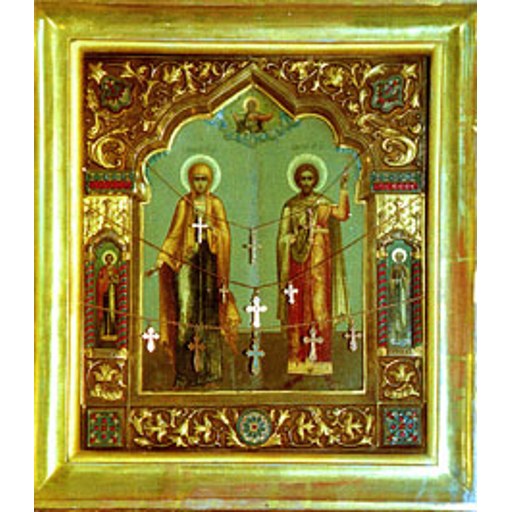
old Russian icon painter (17-19 cen.)
License: Public domain
Adrian and Natalia of Nicomedia
Saint- Life Span
- d. 306
- Feast Day
- 26 August (Eastern Orthodox); 8 September (Roman Catholic)
- Church
- Catholic
Places
Roles & Family
Religious Information
Patronage
soldiers;prison guards;butchers;arms dealers;epileptics;plague;Geraardsbergen
Biography
Adrian (also called Hadrian) and Natalia of Nicomedia are early Christian saints venerated as a married couple in Eastern Orthodox and Roman Catholic tradition. They are associated with Nicomedia, then an imperial residence in Bithynia in northwestern Asia Minor, during the Great Persecution of the early fourth century under Diocletian and his colleagues. In the received legend, Adrian was a pagan of noble family who served as an officer at the imperial court, sometimes described as a hereditary official or a member of the military guard, and was about twenty-eight years old at the time of the events. Natalia, his wife, is portrayed as already a Christian who had kept her faith hidden. No independent contemporary documentation of their lives survives; what is known comes from Greek and Latin passiones that circulated in late antiquity and the early Middle Ages.
According to that hagiographical tradition, Adrian was present while a group of Christians, commonly numbered twenty-three, were being examined and tortured for refusing to sacrifice to the gods. Moved by their constancy and by their words about the hope of resurrection and eternal life, he openly professed Christianity and was at once arrested and imprisoned. Natalia then revealed her own faith, visited him in prison, kissed his bonds, and urged him not to yield. She is said to have encouraged the other prisoners as well and to have prepared her husband for martyrdom, in some versions disguising herself in order to remain near him when access to the jail was restricted.
The legend describes Adrian’s execution in graphic terms: after various tortures his limbs were crushed or cut off upon an anvil, and he was beheaded. Western sources most often give the date as 4 March 306, though some traditions place the martyrdom in 304, within the same wave of persecution. Natalia recovered a relic, typically described as one of his severed hands, and kept it. After Adrian’s death a pagan suitor sought to marry her; she fled Nicomedia and took refuge at Argyropolis on the Bosporus, near Byzantium. There she died, in most accounts of natural causes not long afterward, and was buried near the relics of her husband. Because of her witness she is venerated together with him, whether or not she herself was put to death.
Their cult became established in the Byzantine world and later in the Latin West. The Eastern Orthodox Church keeps their feast on 26 August; the Roman Martyrology lists Adrian on 8 September. Relics attributed to Adrian were claimed in later centuries at several centres, including the church of Sant’Adriano al Foro in the Roman Forum, installed in the former Curia Julia, and the collegiate church of Geraardsbergen in Flanders, which became an important focus of his medieval cult in the Low Countries. Adrian was invoked as a military saint and as patron of soldiers, prison guards, butchers, and arms dealers, and against plague and epilepsy. The historical kernel, if any, cannot be recovered beyond the likelihood of a Nicomedian martyr named Adrian in the Diocletianic persecution; Natalia’s story and the more elaborate details belong to the literary development of the passio.