Aelhaearn is a saint of the Catholic Church. Aelhaearn's feast day is celebrated on 2 November. Aelhaearn is the patron saint of Llanaelhaearn;Guilsfield.
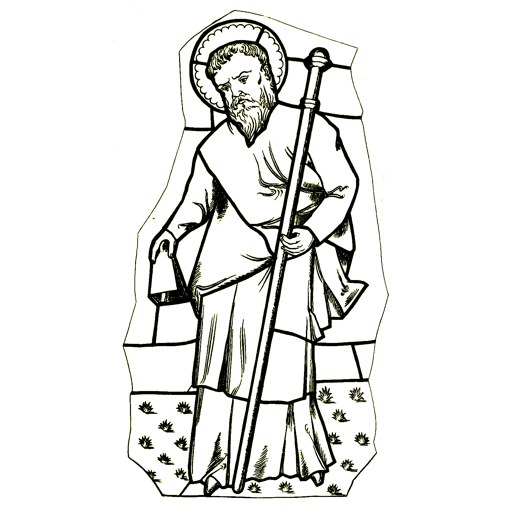
Stained glass: 15th-century Bretish artistSketch: 19th-century British artist
License: Public domain
Aelhaearn
Saint- Feast Day
- 2 November
- Gender
- male
- Church
- Catholic
Places
Roles & Family
Patronage
Llanaelhaearn;Guilsfield
Biography
Aelhaiarn, whose name is also spelled Aelhaearn and is conventionally explained from the Welsh elements ael (brow) and haiarn (iron), is an early medieval Welsh saint customarily assigned to the seventh century. He is the titular saint of Llanaelhaearn on the Llyn peninsula in Gwynedd and of Guilsfield, known in Welsh as Cegidfa, in Powys. No contemporary charter, inscription, or annal names him; what can be said of his life depends on later genealogies of the Welsh saints, on a miracle story attached to the legend of Saint Beuno, and on the evidence of church dedications and a holy well. Historians therefore treat him as a figure of local cult whose biographical outline is traditional rather than demonstrable in detail.
The medieval tract Bonedd y Saint lists Aelhaiarn among the sons of Hygarfael ap Cyndrwyn of Llys Pengwern in Powys, and as a brother of the saints Llwchaiarn and Cynhaiarn. Pengwern was a royal centre of early Powys, often located in the vicinity of Shrewsbury, so this pedigree, if it preserves a genuine memory, would make Aelhaiarn a member of a Powysian aristocratic kindred that furnished several local saints. A different but not necessarily contradictory tradition, found in later Welsh recensions of the Life of Saint Beuno, presents Aelhaiarn as a disciple of Beuno, the monastic founder of Clynnog Fawr in Arfon. Beuno's activity is usually placed in the first half of the seventh century, and Clynnog lies only a short distance from Llanaelhaearn. Scholars have suggested that a cleric from Powys may have entered Beuno's community in Gwynedd, or that originally distinct cults in Powys and on Llyn were later attached to a single name. Either reading remains conjectural.
The most elaborate narrative associated with Aelhaiarn is a restoration miracle. A sixteenth-century Welsh text connected with Beuno's hagiography relates that Aelhaiarn was travelling by night to visit Beuno at Clynnog when wild animals attacked, killed, and tore him to pieces. Beuno collected the scattered bones and flesh, reassembled the body, and by prayer raised Aelhaiarn from the dead. One eyebrow had been destroyed and could not be recovered; Beuno replaced it with iron, and the saint thereafter bore the name that commemorates the metal brow. The story belongs to a familiar Insular pattern in which the monastic father exhibits power over death and the disciple's body becomes a living relic of the miracle. It has no independent historical value, but it accounts for the unusual epithet and binds Aelhaiarn's memory to Beuno's monastery.
Devotion to Aelhaiarn is visible in the landscape of the two parishes that keep his name. The church of Llanaelhaearn occupies a curvilinear yard of a kind frequently linked with early medieval Welsh foundations, and the parish preserved a well, Ffynnon Aelhaiarn, to which healing properties were attributed. Guilsfield's parish church, in the heart of historical Powys, is likewise dedicated to him and accords with the Pengwern genealogy. His feast day is given as 2 November in the principal modern compilations of British saints. Like almost all saints of the early Welsh church, he was venerated by local custom long before the age of papal canonization and was never the object of a formal process at Rome. The surviving evidence permits only a cautious conclusion: that in the seventh century, or in the memory of that century, a monastic or eremitical figure named Aelhaiarn was honoured in Gwynedd and in Powys, that later ages explained his name by a colourful miracle of Saint Beuno, and that his cult remained parochial rather than national.