Aemilianus of Durostoro is a saint of the Catholic Church (d. 362). Aemilianus of Durostoro's feast day is celebrated on 18 July.
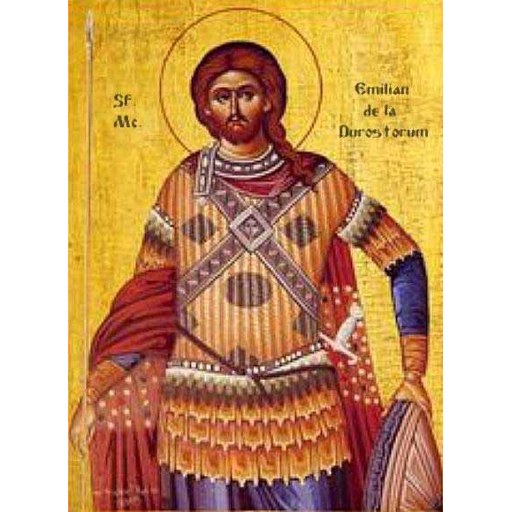
Unknown authorUnknown author
License: Public domain
Aemilianus of Durostoro
Saint- Life Span
- d. 362
- Feast Day
- 18 July
- Gender
- male
- Church
- Catholic
Places
Roles & Family
Biography
Aemilianus of Durostorum (also Emilian of Dorostolum, Aemilian of Durostorum, and in Italian usage Emiliano di Durostoro) was a Christian martyr of the mid-fourth century, put to death at Durostorum, a Roman legionary and administrative city on the south bank of the Danube in the province of Moesia Inferior, the site of present-day Silistra in Bulgaria. The earliest liturgical witnesses, including the Hieronymian Martyrology and the Roman Martyrology, place his passion there during the reign of the emperor Julian (361–363), whose attempt to restore public pagan cult produced a number of local martyrdoms. No contemporary non-hagiographical source records his birth, parentage, or occupation, and no year of birth is known. Later Greek and Slavic lives present him as a slave or household servant of a local official named Capitolinus; some Western notices simply call him a Christian of the city. An ethnic label as a Slav, found in certain Orthodox synaxaria, is anachronistic for a fourth-century inhabitant of Moesia and reflects later Balkan appropriation of the cult rather than a historical fact.
According to the traditional passio, an imperial order required sacrifice to the gods, and the people of Durostorum assembled at a temple. Aemilianus entered the shrine, smashed the idols, and overturned the altar. The next day a peasant was arrested for the deed. Aemilianus then came forward of his own accord, confessed that he alone was responsible, and declared that he was a Christian and that the images were lifeless and unworthy of honour. He was brought before Capitolinus, styled in the sources as prefect or governor. In some recensions Capitolinus is said to have been Aemilianus’s own master. He urged the prisoner to recant, restore the cult, and escape punishment. Aemilianus refused.
He was then tortured, the passions mentioning scourging, and condemned to death by fire. He was led to the bank of the Danube and burned alive. Calendars of both East and West keep his feast on 18 July. Many hagiographical compilations give the year as 362, which falls within Julian’s reign; that year is traditional and is not confirmed by an independent dated inscription or chronicle. The stable core of the tradition is a Christian of Durostorum executed by burning under a prefect Capitolinus in Julian’s time, a notice already present in late antique martyrology.
Aemilianus held no episcopal, patriarchal, or papal office and is not associated with a religious order. Nothing reliable is known of a wife or children. His cult is that of an early martyr, established by liturgical commemoration long before later formal processes of canonisation or beatification. The Roman Martyrology commemorates him on 18 July at Durostorum in Moesia as the martyr burnt alive under Julian the Apostate by the prefect Capitolinus. The Eastern Orthodox Church honours the Holy Martyr Emilian of Dorostolum on the same date. No authenticated relics or burial site are documented in early sources, and no ancient patronage of particular places, trades, or illnesses is securely attached to his name beyond the local connection with Durostorum itself.