Aemilianus is a saint of the Catholic Church (d. 574). Aemilianus's feast day is celebrated on 12 November. Aemilianus is the patron saint of Castile.
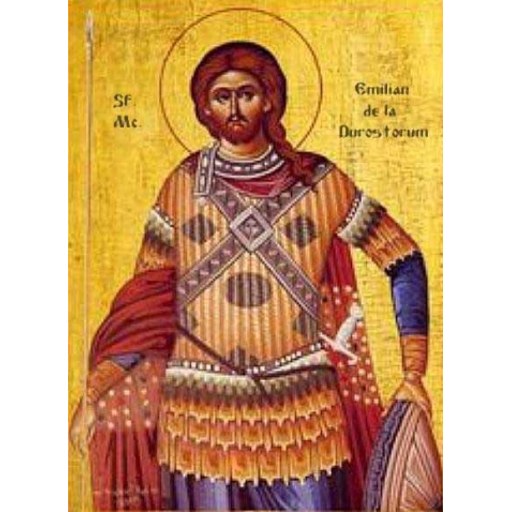
https://catholicsaints.info/tag/name-aemilian
License: unknown
Aemilianus
Saint- Life Span
- d. 574
- Feast Day
- 12 November
- Gender
- male
- Church
- Catholic
Places
Roles & Family
Patronage
Castile
Biography
Saint Aemilianus, known in Spanish as San Millán de la Cogolla, was a hermit and priest who lived in Visigothic Hispania in the fifth and sixth centuries. The principal ancient source for his life is the Vita Sancti Aemiliani composed by Braulio, bishop of Zaragoza, in the middle of the seventh century. According to Braulio, Aemilianus was born in the village of Vergegium, now identified with Berceo in the Rioja. He passed his youth as a shepherd. At about the age of twenty he left that occupation, sought out a hermit named Felix who dwelt near the fortress of Bilibio, and learned from him the practices of the eremitical life.
After decades spent in solitude he was ordained priest by Didymus, bishop of Tarazona, and given charge of a parish. His rigorous personal austerity and his practice of giving church property to the poor aroused opposition, and he was deprived of his pastoral office. He then retired to a cave in the Cogolla mountains, where a community of disciples formed around him. Braulio’s Life ascribes to him miracles of healing and exorcism. Later legendary accretions, absent from the seventh-century Vita, portray him appearing as a heavenly knight at the Battle of Simancas in 939, an episode that helped make him a patron of Castile.
Traditional chronology places his death on 12 November 574, at a very advanced age. He was buried in his cave, which became the monastery of San Millán de Suso. A second monastery, San Millán de Yuso, was founded in the valley in the eleventh century. The houses of San Millán became a major center of monastic life and of early Castilian literacy; the Glosas Emilianenses, among the earliest written records of Iberian Romance, originated there. The thirteenth-century poet Gonzalo de Berceo, a native of the saint’s village, wrote a verse life that further spread the cult.
The historical setting of Aemilianus’s life was the Visigothic kingdom in the generations around the conversion of Reccared from Arianism, although the saint himself belonged to an earlier cohort. His cult is one of the oldest continuously attested in the Rioja and was promoted by the powerful monastery that grew from his tomb. Medieval kings of Navarre and Castile endowed the house, and it remained an important pilgrimage site. Although many details of the later legend cannot be verified, the core of Braulio’s narrative—an ascetic shepherd who became a priest, was rejected by his flock, and ended his days as a wonder-working hermit—has been accepted by historians as reflecting a genuine sixth-century holy man of the Iberian countryside. Aemilianus is venerated as patron of Castile, and his feast is kept on 12 November.