Agape, Chionia, and Irene is a saint of the Catholic Church (d. 304). Agape, Chionia, and Irene's feast day is celebrated on 3 April (West); 16 April (East).
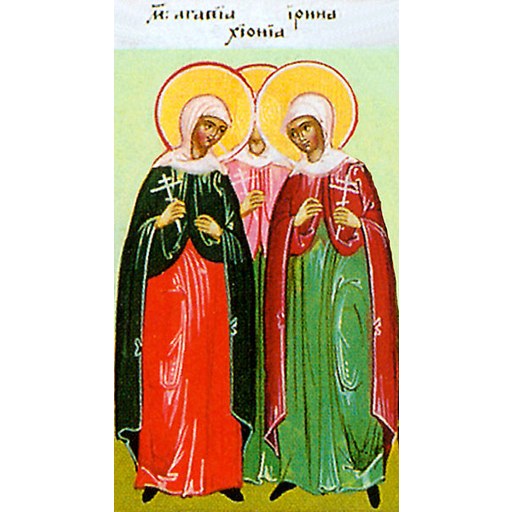
Ikonopisatel
License: Public domain
Agape, Chionia, and Irene
Saint- Life Span
- d. 304
- Feast Day
- 3 April (West); 16 April (East)
- Gender
- female
- Church
- Catholic
Places
Roles & Family
Biography
Agape, Chionia, and Irene were three Christian virgin sisters martyred at Thessalonica in the Roman province of Macedonia during the Great Persecution under the Emperor Diocletian, in the year traditionally given as 304. Their Greek names mean Love, Snow, and Peace. No reliable source records the year or exact place of their birth; they are known from an early Latin Passion that many modern scholars, following Hippolyte Delehaye and Herbert Musurillo, regard as substantially historical in its judicial core, even though later recensions added legendary colour. The sisters appear in the Roman Martyrology and in Eastern synaxaria as a single group of virgin martyrs associated with Thessalonica.
According to the Passion, after Diocletian’s edicts of 303 ordered the surrender and destruction of Christian scriptures and required sacrifice to the gods, the three women withdrew from the city to a mountain in the neighbourhood of Thessalonica, taking sacred books with them. They were discovered, arrested, and brought before Dulcitius, the prefect. Interrogated, they refused to eat food that had been offered to idols and would not deny their faith. Agape and Chionia were condemned and burned alive. Irene, described as the youngest, was at first reserved for a different penalty: the prefect ordered that she be exposed in a public brothel. The Passion states that she remained unmolested there. She was later taken to a high place and killed; the earlier form of the acts says she was shot with an arrow, while some later versions say she too was burned. Possession of the forbidden books is a central charge in the interrogation of Irene.
Medieval legend greatly expanded this relatively sober narrative. In a well-known later recension, Dulcitius becomes infatuated with the prisoners and, in a fit of madness in the dark, embraces kitchen pots and pans, believing them to be the women. That comic episode was dramatized in the tenth century by the German canoness Hrotsvitha of Gandersheim in her play Dulcitius. A still later and historically unfounded tradition made the three sisters daughters of Saint Anastasia. These accretions should be distinguished from the earlier martyr acts, whose setting in Thessalonica under a named prefect during the book-burning phase of the Diocletianic persecution remains the most secure outline of their story.
The sisters have been venerated in both East and West from late antiquity. The Roman Martyrology commemorates them on 3 April; the Eastern Orthodox Church keeps their memory on 16 April. They are honoured as virgin martyrs. Nothing certain is known of their burial place, of any formal religious profession beyond the title of virgin, or of any specific patronages attached to them in later devotion. Their historical importance lies chiefly in the relatively early Passion, which preserves a rare glimpse of how the edict against the scriptures was applied in Macedonia and how three young women of Thessalonica answered it.