Agatha of Sicily is a saint of the Pre-Schism (Universal) Church (d. 251). Agatha of Sicily's feast day is celebrated on 5 February. Agatha of Sicily is the patron saint of Catania;Sicily;Malta;Palermo;San Marino;Zamarramala;bell-founders;breast cancer;diseases of the breast;bakers;nurses;wet nurses;rape victims;torture victims;fire;earthquakes;volcanic eruptions;Mount Etna;jewelers;martyrs;natural disasters;single laywomen.
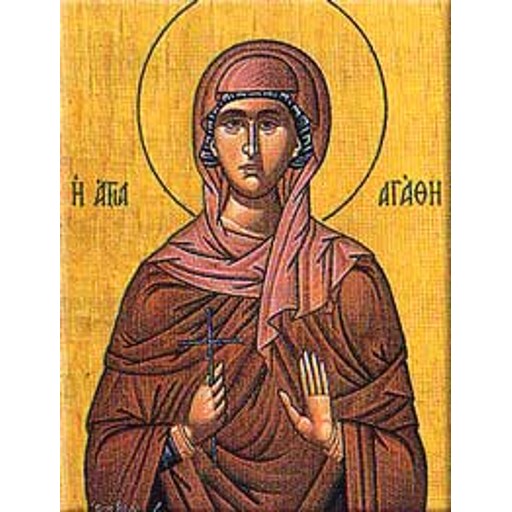
Original author unknown; originally uploaded by Geleyns at nl.wikipedia
License: Public domain
Agatha of Sicily
Saint- Life Span
- d. 251
- Feast Day
- 5 February
- Gender
- female
- Church
- Pre-Schism (Universal)
Places


Relics & Where to Venerate
Location unknown
The bodily remains of Agatha of Sicily are a first-class relic. Venerated at Catania Cathedral.
Roles & Family
Patronage
Catania;Sicily;Malta;Palermo;San Marino;Zamarramala;bell-founders;breast cancer;diseases of the breast;bakers;nurses;wet nurses;rape victims;torture victims;fire;earthquakes;volcanic eruptions;Mount Etna;jewelers;martyrs;natural disasters;single laywomen
Biography
Saint Agatha of Sicily is one of the most highly venerated virgin martyrs of Christian antiquity and one of the few women named in the Roman Canon of the Mass, a liturgical distinction that attests to the early and widespread establishment of her cult. Almost nothing about her life can be recovered from contemporary third-century documents. The principal narrative source is a Latin passio, generally assigned by scholars to the fifth or sixth century, which follows the conventional pattern of late antique martyr acts and is regarded as largely legendary in its dialogue, miracles, and sequence of tortures; Greek recensions of the legend also circulated. Tradition places her in Sicily in the mid-third century and associates her especially with Catania, though a competing claim names Palermo as her birthplace. She is described as the daughter of a wealthy and noble family who, while still young, consecrated her virginity to Christ. No historically verified year of birth survives; later computations that assign a round figure such as 231 are not grounded in contemporary evidence.
The passio relates that a Roman official named Quintianus, often identified as holding consular or procuratorial authority in Sicily during the persecution under the emperor Decius, sought to marry her. When Agatha refused him on the grounds of her Christian faith and her vow of virginity, he used the imperial edicts against Christians to have her arrested. She was first consigned to a brothel kept by a woman named Aphrodisia, whose attempts to corrupt her failed. Returned to Quintianus, she was tortured on the rack and, in the episode that became central to her iconography, had her breasts cut off. Legend holds that the apostle Peter appeared to her in prison and healed her wounds. She was then rolled over live coals mixed with broken potsherds and died in prison. Traditional dating places her death on 5 February 251, within the Decian persecution. A later Catania tradition recounts that, about a year after her martyrdom, her veil was carried in procession and was believed to have halted an eruption of Mount Etna, inaugurating her long role as protectress of the city against volcanic fire.
Modern historians generally accept that a Christian woman named Agatha was martyred at Catania and that her tomb became a focus of veneration at an early date, while treating the narrative embellishments of the passio as unhistorical. Her name appears in the Martyrologium Hieronymianum and in the sixth-century calendar of Carthage. A church in her honor existed in Rome by late antiquity (later Sant'Agata dei Goti), and Pope Gregory I refers to her cult. She was likewise commemorated in the East. Throughout the Middle Ages her relics, or portions of them, were claimed by Catania, where the cathedral that bears her name remains the center of her cult; other relics were distributed to churches across Europe. Because she belongs to the pre-congregation era of the saints, there was no formal papal canonization or beatification of the later medieval and modern type; her cult is ancient and liturgical rather than the product of a documented process. The annual feast on 5 February, especially the multi-day festival in Catania, has continued into the modern period as one of the major popular celebrations of a virgin martyr in the Catholic world.
In Christian art Agatha is typically shown holding a platter or salver on which her severed breasts rest, or holding the palm of martyrdom, a candle, or a veil. She is the principal patron of Catania and a patron of Sicily and of Malta, and she is invoked against eruptions of Mount Etna, against fire and earthquakes, and by those suffering from diseases of the breast, including breast cancer. She is also regarded as a patron of nurses and wet nurses, of bell-founders, of bakers, of jewelers, of victims of rape and of torture, of single laywomen, and of a number of towns in Italy, Spain, and elsewhere that adopted her cult, among them Zamarramala. A cautious historical account must distinguish the plausible fact of an early Catania martyr and an ancient liturgical cult from the unrecoverable particulars of her life and passion.