Agnes Maria Huyn van Amstenrade is a blessed of the Catholic Church.
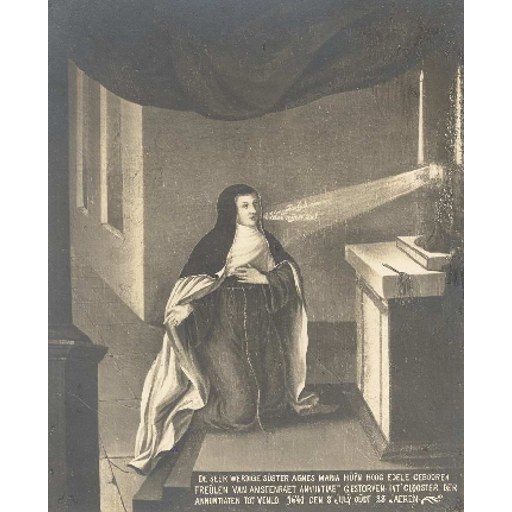
The original uploader was Donpipone at German Wikipedia.
License: Public domain
Agnes Maria Huyn van Amstenrade
Blessed- Gender
- female
- Church
- Catholic
Places
Roles & Family
Biography
Agnes Maria Huyn van Amstenrade belonged to the Huyn van Amstenrade family, a lineage of the lesser nobility whose name is tied to the castle and former lordship of Amstenrade in South Limburg. This region, situated between the Meuse and the German borderlands, formed part of a complex mosaic of jurisdictions in the early modern period, including territories of the Spanish Netherlands, the Dutch Republic, the Prince-Bishopric of Liège, and the Holy Roman Empire. Noble families such as the Huyns typically held local seigneurial rights, participated in regional estates, and maintained Catholic identity in an area of mixed confessional loyalties.
The Huyn family is attested in Limburg from the later Middle Ages onward and gained greater visibility in the sixteenth and seventeenth centuries. Like other houses of their rank, they intermarried with neighboring noble families, served in military or administrative capacities, and acted as patrons of churches and religious houses. Female members of such families were frequently placed in convents, either as a vocation or as a socially acceptable provision, or they contracted marriages that consolidated land and alliances. The political and religious upheavals of the Eighty Years' War and the subsequent wars of Louis XIV affected the fortunes of Limburg nobility, sometimes forcing families to choose sides or to seek protection from larger powers.
Reliable, widely published biographical details concerning Agnes Maria Huyn van Amstenrade herself are scarce. She does not appear among the well-documented saints, blesseds, or major abbesses of the Low Countries, nor is a detailed contemporary vita readily available in standard historical literature. Genealogical compilations of the Limburg aristocracy mention various women of the Huyn line, yet without access to unpublished archival sources such as parish registers, convent necrologies, or family papers, it is not possible to confirm her exact dates of birth and death, her marital status, or whether she entered a religious order.
Amstenrade Castle, the family's principal seat, originated as a medieval stronghold and was later transformed into a more residential château. The surrounding countryside, including villages such as Amstenrade, Merkelbeek, and nearby Heerlen, remained predominantly Catholic. Noblewomen of the seventeenth century in this milieu typically received an education emphasizing piety, household economy, and the social graces expected of their rank. Many contributed to the religious life of the region through donations, the founding of chapels, or by taking the veil themselves.
In the present state of readily verifiable knowledge, Agnes Maria Huyn van Amstenrade remains an obscure figure whose individual story has not been the subject of extensive historical or hagiographical treatment. She illustrates the numerous women of provincial nobility whose lives were recorded primarily in legal documents, family chronicles, and local ecclesiastical records rather than in printed biographies. Additional information, should it exist, would most likely be found in the regional archives of Limburg or in the records of religious communities that once existed in the Meuse-Rhine area.