Agnes of Bavaria is a blessed of the Catholic Church (1335 - 1352).
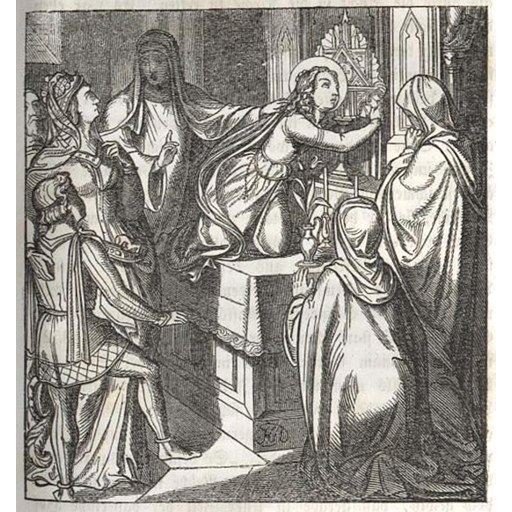
zeitgenössischer Stecher, 1850
License: Public domain
Agnes of Bavaria
Blessed- Life Span
- 1335 - 1352 (age 17)
- Gender
- female
- Church
- Catholic
Places
Relics & Where to Venerate
Location unknown
The bodily remains of Agnes of Bavaria are a first-class relic. Venerated at Frauenkirche.
Roles & Family
Religious Information
Biography
Agnes of Bavaria was a fourteenth-century princess of the House of Wittelsbach who lived as a Poor Clare nun in Munich. She was born in 1335 in Munich, in the Duchy of Bavaria within the Holy Roman Empire, as a daughter of Louis IV, Holy Roman Emperor (Louis the Bavarian), and his second wife, Margaret II, Countess of Hainaut, Holland, and Zeeland. Through her father she belonged to the principal Bavarian line of the Wittelsbachs, then at the height of its imperial power; through her mother she was connected to the Avesnes dynasty that ruled large territories in the Low Countries. Louis IV’s reign, marked by his struggle with the Avignon papacy, his imperial coronation, and the consolidation of Wittelsbach influence in Bavaria and beyond, formed the political setting of her childhood. She was one of a numerous group of siblings that included later Bavarian dukes such as Louis VI the Roman, William I, Albert I, and Otto V, as well as sisters who were married into other princely houses of the Empire.
A community of the Order of Saint Clare, the enclosed Franciscan Second Order popularly known as the Poor Clares, existed in Munich and enjoyed the patronage of the imperial family. Agnes was sent to this monastery to be educated, a practice not unusual for daughters of ruling houses who might later take the veil. In time she herself entered the community as a nun. The Poor Clare life to which she was professed was one of enclosure, poverty, and contemplative prayer, following the form of life associated with Clare of Assisi. Contemporary administrative and narrative sources for the Munich house in this generation are sparse, so the precise date of her clothing or profession is not securely recorded, but genealogical and later monastic notices agree that she was raised in the convent from an early age and remained there as a religious.
Her father died in 1347, when Agnes was still a child or young adolescent, and the subsequent partition of Wittelsbach lands among her brothers, together with her mother’s contested rights in Hainaut and Holland, reshaped the family’s political position. There is no evidence that Agnes, living under monastic enclosure, took any part in these secular disputes. Later notices, often brief and partly hagiographical in character, describe her as devout, but they do not preserve a detailed vita, letters, or a record of offices held within the community. She left no known writings. The historical record of her adult religious life is therefore essentially that of a Wittelsbach princess who completed her formation and vows among the Poor Clares of Munich and died there while still in her teens.
Agnes died in Munich on 11 November 1352, at about seventeen years of age. She is presumed to have been buried at the monastery that had been her home, though an independent, fully documented burial notice is not readily available in the standard published sources. In later Bavarian and Franciscan tradition she was sometimes remembered as a figure of youthful piety, and occasional compilations have referred to her as “blessed.” No papal act of beatification or canonization is clearly documented, and she does not occupy a place in the general Roman calendar with an officially assigned feast. Her profile in reliable history remains that of an obscure but well-attested imperial daughter of the mid-fourteenth century who entered the Order of Saint Clare in Munich and died there, rather than that of a widely culted saint with an extensive legendary dossier. The thinness of the primary evidence means that her inner life, the exact circumstances of her vocation, and any local cult that may once have existed cannot be reconstructed with certainty.