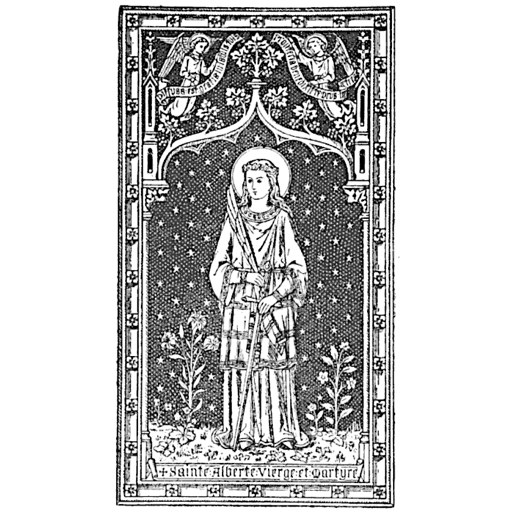
Alberta of Agen is a saint of the Catholic Church (d. 286). Alberta of Agen's feast day is celebrated on 11 March.
Jean Cayla auteur du livre
License: Public domain
Alberta of Agen
Saint- Life Span
- d. 286
- Feast Day
- 11 March
- Gender
- female
- Church
- Catholic
Places
Roles & Family
Biography
Saint Alberta of Agen is venerated as a Christian virgin martyr of late antiquity, associated with the city of Agen in Aquitaine, in what was then Roman Gaul and is now southwestern France. No contemporary inscription, imperial rescript, or early ecclesiastical historian names her. What is known of her belongs to the later hagiographical cycle of the martyrs of Agen, a body of legend that formed around the more famous figure of Saint Faith (Latin Fides; French Sainte Foy). In that tradition Alberta is remembered as a maiden of the local Christian community who accepted the faith through the example or preaching of Faith and who was put to death for refusing to recant. The designation of Agen records the place of her reported martyrdom and cult; a documented place of birth has not been preserved.
The received Passio of Saint Faith, a medieval composition rather than a third-century record, sets the persecution under a prefect named Dacian. Dacian is a conventional antagonist in several Gallic passion narratives and is not independently attested as a historical official at Agen. According to the legend, Faith, a young girl, was arrested, tortured, and executed; her constancy was said to have moved other Christians in the city. Caprasius, who had withdrawn to a hill outside Agen, returned to confess the faith, and Alberta together with further companions was likewise seized and killed. Traditional chronology often places these deaths about the year 286, in the time of Maximian, though some later writers preferred a date in the Great Persecution of Diocletian after 303. Neither dating rests on firm documentary evidence. Alberta is uniformly presented as a virgin; there is no tradition of a husband or of children.
Modern historical criticism treats the Agen martyr stories as largely legendary, while allowing that a local memory of Christians killed in a Roman persecution may underlie the later narratives. Alberta’s own cult remained modest beside that of Saint Faith, whose relics were translated to the abbey of Conques in the ninth century and became the focus of a major medieval pilgrimage. Alberta continued to be listed in martyrologies and in the liturgical tradition of Agen and of the Latin Church more widely. Her feast is kept on 11 March. Like most martyrs of the first Christian centuries, she was not the subject of a formal papal canonization of the later medieval or modern type; her public veneration belongs to the ancient, so-called pre-congregation cultus later reflected in the martyrologies.
No trustworthy account of her family, education, or burial has survived, nor is she associated with any religious order. Monastic orders in the later sense did not exist in the third-century church of Gaul. Subsequent devotion has not attached to her a well-documented list of specific patronages of places, professions, illnesses, or causes. She remains in Christian memory one of the virgin martyrs of Roman Gaul: a figure whose historical outline is faint, but whose story was told to commend steadfast confession of the faith under persecution.