Albertus Magnus is a saint of the Catholic Church (d. 1280). Albertus Magnus's feast day is celebrated on 15 November. Albertus Magnus is the patron saint of scientists;philosophers;natural sciences;medical technicians;students;chemists;Archdiocese of Cincinnati.
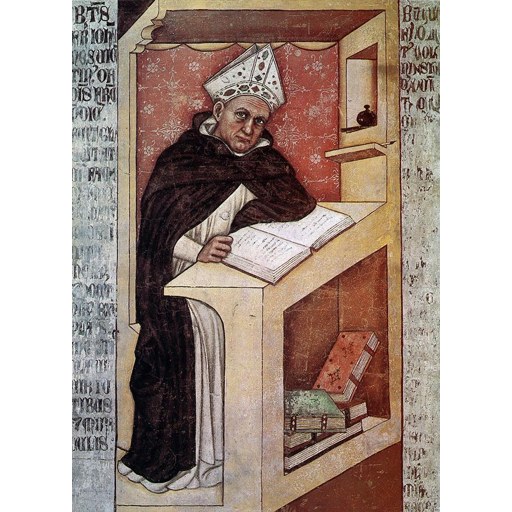
Tommaso da Modena
License: Public domain
Albertus Magnus
Saint- Life Span
- d. 1280
- Feast Day
- 15 November
- Gender
- male
- Church
- Catholic
Places
Relics & Where to Venerate
Location unknown
The bodily remains of Albertus Magnus are a first-class relic. Venerated at St. Andreas Church.
Roles & Family
Religious Information
Patronage
scientists;philosophers;natural sciences;medical technicians;students;chemists;Archdiocese of Cincinnati
Canonization
Biography
Albertus Magnus, known as Saint Albert the Great and sometimes as Albert of Cologne, was a thirteenth-century German Dominican friar, bishop, philosopher, theologian, and naturalist, later declared a Doctor of the Church. He was born at Lauingen on the Danube in Swabia, in what is now Bavaria, into a family of the lesser nobility; later tradition sometimes names his father as a count of Bollstädt, though details of his childhood are sparse. The precise year of his birth is not recorded in contemporary sources. After studies that included time at the University of Padua, he entered the Order of Preachers. He taught in a succession of Dominican houses in German-speaking Europe, including Hildesheim, Freiburg, Regensburg, Strasbourg, and Cologne, and was then assigned to the University of Paris, then the chief center of theological study in Latin Christendom. There he lectured on the Sentences of Peter Lombard and began the long labor of commenting on Aristotle that would occupy much of his career. At Paris and later at the studium generale he helped establish in Cologne, Thomas Aquinas was among his students.
Albert's literary output was vast and encyclopedic. He produced commentaries on the logical, physical, metaphysical, ethical, and political works of Aristotle, as well as on Peter Lombard and on Scripture, and he wrote independent treatises on animals, plants, minerals, and the heavens. In these works he combined the learning of the Greeks, Romans, and Arabic authors with reports of his own observation, and he insisted that in the investigation of nature experiment, not unaided authority, must be the guide. This combination of speculative range and empirical curiosity, together with his role in making the full Aristotelian corpus, including the libri naturales, available to the Latin schools, earned him already in the Middle Ages the epithet Doctor Universalis. He treated theology and philosophy as distinct though related sciences and sought to give each its proper method, a stance that deeply influenced his pupil Aquinas and later Scholasticism.
From 1254 to 1257 Albert served as prior provincial of the Dominican province of Teutonia, traveling widely to visit convents and to represent the order, including in disputes at the papal court over the rights of the mendicants in the universities. In 1260 Pope Alexander IV appointed him Bishop of Regensburg. He accepted the office reluctantly, administered the diocese with personal austerity and an effort at reform, and resigned after about two years in order to return to teaching and writing, which he regarded as his true vocation. He subsequently preached in German lands in support of a crusade at papal request and continued to teach at Cologne. After the death of Thomas Aquinas in 1274, later tradition holds that Albert went to Paris to defend his former pupil's doctrine against its critics. In extreme old age he remained in Cologne; hagiographical accounts report that his memory failed before the end.
Albert died in Cologne on 15 November 1280 and was buried in the Dominican church of Saint Andrew (Sankt Andreas) in that city, where his tomb and relics are still venerated. Veneration of him grew in the later Middle Ages. Pope Gregory XV beatified him in 1622. On 16 December 1931 Pope Pius XI canonized him and at the same time proclaimed him a Doctor of the Church. The Roman Catholic Church keeps his feast on 15 November. He is invoked as patron of scientists, philosophers, students of the natural sciences, medical technicians, and chemists, and he is among the patrons of the Archdiocese of Cincinnati.