Alexander Hotovitzky is a saint of the Eastern Orthodox Church (1872 - 1937). Alexander Hotovitzky's feast day is celebrated on December 4.
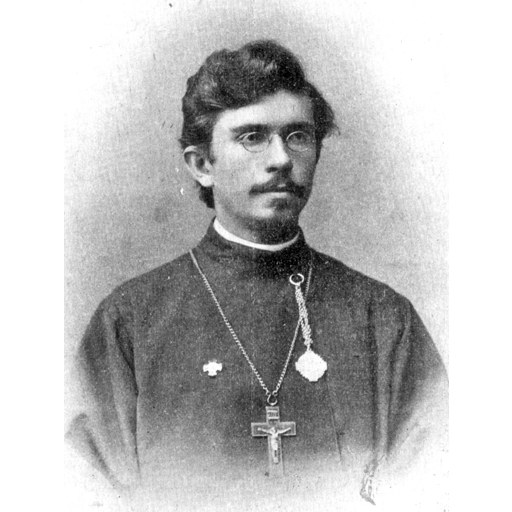
Unknown authorUnknown author
License: Public domain
Alexander Hotovitzky
Saint- Life Span
- 1872 - 1937 (age 65)
- Feast Day
- December 4
- Gender
- male
- Church
- Eastern Orthodox
Places
Relics & Where to Venerate
Location unknown
The bodily remains of Alexander Hotovitzky are a first-class relic. Venerated at Donskoe cemetery.
Roles & Family
Canonization
Biography
Alexander Alexandrovich Hotovitzky was born on 11 February 1872 in Kremenets, in the Volhynia Governorate of the Russian Empire, the son of a priest who served as rector of the Volhynia Theological Seminary. Raised in a clerical household, he received his secondary theological education at that seminary and then entered the Saint Petersburg Theological Academy, graduating in 1895. In the same year the Holy Synod assigned him to the Russian Orthodox mission in North America, then under the Diocese of the Aleutians and Alaska.
After arriving in the United States he married and was ordained to the priesthood in 1896 in San Francisco by Bishop Nicholas (Ziorov). He was appointed to Saint Nicholas parish in New York City, a community composed largely of immigrants from Galicia, Carpatho-Russia, and other regions of the Austro-Hungarian and Russian empires. Under his pastorate the congregation expanded rapidly; he organized the building of Saint Nicholas Cathedral on East 97th Street, which was consecrated in 1902 and became a central church of the North American mission. Hotovitzky edited the bilingual journal known as the Russian Orthodox American Messenger, assisted in the establishment of new parishes, and worked closely with Bishop Tikhon (Bellavin), later Patriarch of Moscow, and with other clergy of the mission, including Saint Raphael of Brooklyn. He was known for pastoral work among immigrant communities and for efforts to present Orthodox Christianity in English to a wider American public.
In 1914 Archpriest Alexander was recalled to Russia. He served for a time as rector of the Dormition (Uspenski) Cathedral in Helsinki, then in the Grand Duchy of Finland, before being transferred to Moscow, where he was attached to the Cathedral of Christ the Savior. After the revolutions of 1917 he remained in Moscow, served on diocesan bodies, and was a trusted collaborator of Patriarch Tikhon. He opposed the state-sponsored Renovationist (Living Church) schism of the early 1920s and took part in the defense of patriarchal authority and traditional Orthodox practice. He was arrested more than once in the early Soviet period, including in connection with the campaign to confiscate church valuables, and spent periods in prison and exile.
During the Great Purge he was arrested again in 1937, charged with counter-revolutionary activity, and condemned by an NKVD troika. He was executed by firing squad on 19 August 1937. The Russian Orthodox Church glorified him as a hieromartyr in 1994 among the New Martyrs and Confessors of Russia. He is also venerated by the Orthodox Church in America, which commemorates his missionary labors in the United States as well as his martyrdom. His relics were not recovered; like many victims of 1937, he has no known grave.