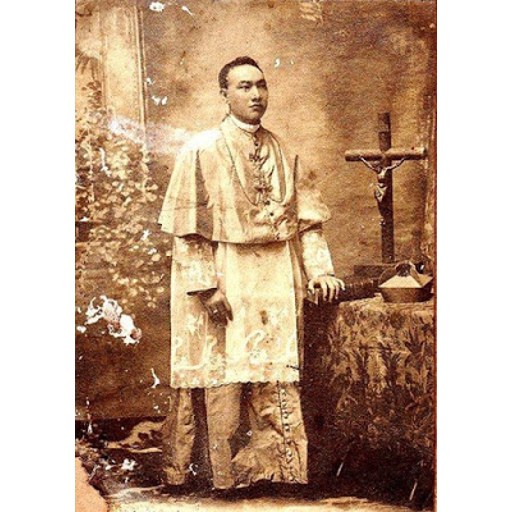
Alfredo Versoza is a servant of god of the Catholic Church (1877 - 1954).
Vigan Cathedral
License: Public domain
Alfredo Versoza
Servant of God- Life Span
- 1877 - 1954 (age 77)
- Gender
- male
- Church
- Catholic
Places
Roles & Family
Biography
Alfredo Verzosa y Florentín was a Filipino Roman Catholic bishop of the Latin Rite, remembered as a long-serving ordinary of Lipa and later as a Servant of God in a cause for beatification. He was born on 9 December 1877 in Vigan, Ilocos Sur, in the Spanish colonial Philippines, and received his clerical formation in that northern Luzon setting before further study in Manila, including work associated with the University of Santo Tomas. He was ordained a priest on 24 December 1904. In the years that followed he served as a diocesan priest in the Ilocos region rather than as a member of a religious order, occupying parish and other pastoral posts in the early American colonial period, when the Philippine Church was being reorganized after the end of Spanish rule and the first generations of native Filipino bishops were being appointed.
Pope Benedict XV named him Bishop of Lipa in 1916; he was consecrated in 1917 and thereby became the first Filipino to head that Batangas see. His episcopate lasted through the remainder of American colonial government, the Commonwealth, the Japanese occupation of the Second World War, and the first years of the independent Republic of the Philippines. In Lipa he promoted catechesis and Catholic schooling and sought to rebuild diocesan life in a largely rural jurisdiction. In 1923 he founded the Missionary Catechists of the Sacred Heart, a congregation of women religious devoted to catechetical instruction, which became one of the principal institutional legacies of his administration. The Second World War brought severe destruction to Batangas, including heavy damage in Lipa; Verzosa remained associated with the diocese through that crisis and the difficult reconstruction that followed.
The later 1940s also saw the reported Marian apparitions at the Carmelite monastery in Lipa in 1948, later linked to the title Our Lady, Mediatrix of All Grace. As ordinary, Verzosa was drawn into the local handling of those events and at an early stage allowed related public devotion. A subsequent investigation by Philippine bishops issued a negative judgment in 1951. That same year Verzosa resigned the Diocese of Lipa and was appointed titular bishop of Lysinia. Historians have discussed possible connections between the Lipa controversy, Roman and nunciature involvement, and his departure from the see, but the documented fact is the resignation and titular appointment when he was already in old age after more than three decades in Lipa.
He retired to his native Vigan, where he died on 25 June 1954. He was never a pope or a patriarch, remained a celibate diocesan prelate, and was not beatified or canonized. A cause for his beatification was later introduced in the Catholic Church, and he is therefore styled Servant of God. In Philippine Catholic memory he is associated above all with the see of Lipa in the first half of the twentieth century, with the catechetical congregation he founded, and with a life of episcopal ministry spanning colonial, wartime, and early republican conditions. No universally established feast day or list of patronages attaches to him in the manner of a canonized saint.