Alor de Quimper is a saint of the Catholic Church. Alor de Quimper's feast day is celebrated on 26 October.
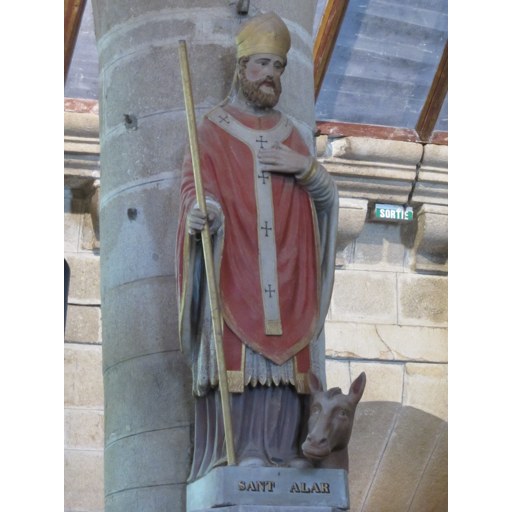
Bibar
License: CC BY-SA 3.0
Alor de Quimper
Saint- Feast Day
- 26 October
- Gender
- male
- Church
- Catholic
Roles & Family
Biography
Saint Alor, also recorded as Alorus or Alorius, is a Breton saint traditionally counted among the earliest bishops of Quimper, the episcopal see of Cornouaille in western Armorica. He is an obscure figure. No contemporary charter, letter, or inscription names him, and no early medieval vita of independent historical value has survived. His place in history rests on later episcopal catalogues of Quimper, on local liturgical calendars, and on the survival of his name in Breton church dedications and toponymy. Modern historians therefore treat him as a representative of the poorly documented first generations of the Cornouaille episcopate rather than as a person whose life can be reconstructed in detail.
The church of Cornouaille took shape in the fifth and sixth centuries, as Roman administration receded from Armorica and Breton-speaking communities established their own principalities and monasteries. Saint Corentin stands at the head of the traditional list of bishops of Quimper, surrounded by the later Gradlon cycle of legend. Subsequent names in the medieval catalogues, among which Alor appears, were assembled long after the period they describe. Some lists number Alor as the fourth bishop of the see. That numbering, and any attempt to assign him a precise year of consecration or death, cannot be verified from sources close to his lifetime. Figures such as a death about the mid-fifth century that appear in later compilations belong to this secondary tradition and should not be taken as established fact.
Nothing reliable is known of Alor's birth, family, or formation. Later piety sometimes linked early Breton bishops to the great monasteries of the peninsula, especially Landévennec, but no evidence of independent weight attaches Alor to a particular religious order or monastic founder. He is remembered as a diocesan bishop. There is no documentation of a spouse or of children, nor any explicit contemporary statement that he lived under a monastic rule; the marital practice of the early Breton clergy is a general historical question, not a fact established for this individual. His place of death and burial are likewise unrecorded.
His cult is local to Brittany. Breton calendars and the seventeenth-century hagiographical collections, notably Albert Le Grand's lives of the saints of Armorican Brittany, assign him a feast on 26 October. Churches and place-names in Finistère preserved the dedication, which is how many otherwise shadowy Armorican saints remained in popular and liturgical memory. He was not the subject of a formal papal canonization of the type that became standard in the later Middle Ages. Like most saints of the first millennium in the Celtic west, he entered the calendar through long-standing episcopal and popular veneration rather than through a dated decree of Rome.
Beyond the name, the episcopal title, the local feast, and the existence of a cult, the record is silent. No early miracle collection, no authentic correspondence, and no archaeological identification of a tomb can be cited. Alor therefore illustrates both the continuity of Christian life in early medieval Cornouaille and the severe limits of the evidence for its first bishops. What can be said with caution is that a bishop of this name was remembered in the church of Quimper, that his memory was kept on 26 October, and that later ages regarded him as a saint of the formative period of the Breton church.