Aloysius Gonzaga is a saint of the Catholic Church (1568 - 1591). Aloysius Gonzaga's feast day is celebrated on 21 June. Aloysius Gonzaga is the patron saint of youth;students;Catholic youth;young students;Jesuit novices;Jesuit students;people with AIDS;AIDS caregivers;Castiglione delle Stiviere.
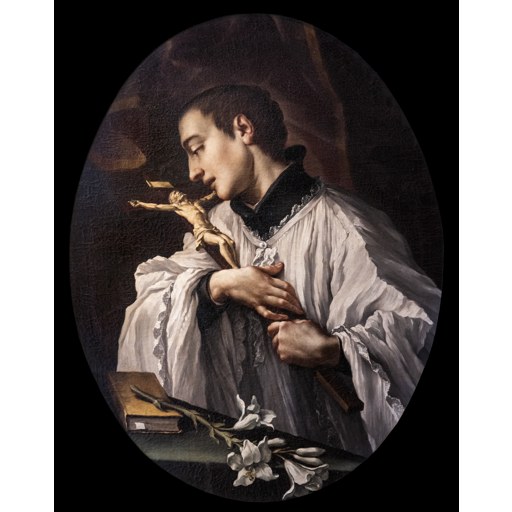
Didier Descouens
License: Public domain
Aloysius Gonzaga
Saint- Life Span
- 1568 - 1591 (age 23)
- Feast Day
- 21 June
- Gender
- male
- Church
- Catholic
Places


Relics & Where to Venerate
Location unknown
The bodily remains of Aloysius Gonzaga are a first-class relic. Venerated at Altar of Saint Aloysius Gonzaga.
Roles & Family
Religious Information
Patronage
youth;students;Catholic youth;young students;Jesuit novices;Jesuit students;people with AIDS;AIDS caregivers;Castiglione delle Stiviere
Canonization
Biography
Aloysius Gonzaga (Luigi Gonzaga) was born on 9 March 1568 at Castiglione delle Stiviere in the Duchy of Mantua, in what is now northern Italy. He was the eldest son of Ferrante Gonzaga, Marquis of Castiglione, and Marta Tana di Santena, who had served at the Spanish court. As heir to a Gonzaga cadet line, he was trained from childhood for arms and princely life; at a very young age he was given miniature weapons and accompanied military reviews. Despite this upbringing he developed an intense piety. Around the age of seven he began daily recitation of the Little Office of Our Lady and other devotions. In 1577 he was sent with his brother Rodolfo to Florence to serve as a page at the court of Grand Duke Francesco I de' Medici, where exposure to court intrigue and violence confirmed his dislike of worldly ambition. In 1580 he received his First Holy Communion from Cardinal Charles Borromeo.
From 1581 to 1584 Aloysius lived at the court of Philip II of Spain as a page to the king's son, the Infante Diego. There he continued a hidden life of prayer, fasting, and reading, especially the lives of Jesuit missionaries. He made a private vow of chastity. After the infante's death and the family's return to Italy, he announced his intention to enter the Society of Jesus. His father, who needed an heir capable of defending the marquisate and who had already obtained a military command for him, opposed the vocation for months. Relatives, including several prelates, eventually helped persuade Ferrante. In November 1585 Aloysius signed a formal act ceding his rights of succession to Rodolfo and entered the Jesuit novitiate of Sant'Andrea al Quirinale in Rome.
In the Society he was known for obedience, humility, and a desire for missionary work that his superiors judged incompatible with his frail health. He studied philosophy and theology at the Roman College. Recurrent illness, including kidney trouble, forced periods of rest. Saint Robert Bellarmine became his confessor and later testified to his virtue in the beatification process. When a severe epidemic swept Rome in 1591, the Jesuits opened a hospital for the destitute sick. Aloysius begged to serve there. He carried dying men from the streets, washed them, and prepared them for the sacraments. He contracted the disease while engaged in this work and, after a lingering illness, died shortly after midnight on 21 June 1591, aged twenty-three, without having been ordained to the priesthood. His body was interred in the church attached to the Roman College, later rebuilt as the Church of Sant'Ignazio, where his relics are still venerated in the Lancellotti Chapel. Bellarmine asked to be buried at his feet.
Popular devotion began immediately. Pope Paul V beatified him on 19 October 1605, only fourteen years after his death. Pope Benedict XIII canonized him on 31 December 1726, together with the Polish Jesuit Stanislaus Kostka, and in 1729 declared him patron of young students. His liturgical feast is 21 June. Because he died while nursing the contagious sick, Pope John Paul II in 1991 named him patron of those suffering from AIDS and of their caregivers. He is also invoked as patron of youth, of Jesuit scholastics, and of his native Castiglione delle Stiviere. Catholic tradition presents him as a model of baptismal holiness in adolescence and of charity unto death.