Alto of Altomünster is a saint of the Catholic Church (d. 760). Alto of Altomünster's feast day is celebrated on 9 February. Alto of Altomünster is the patron saint of Altomünster.
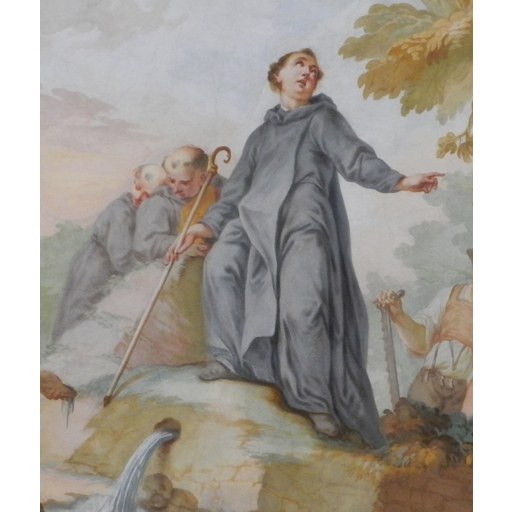
Joseph Magges, Augsburg
License: Public domain
Alto of Altomünster
Saint- Life Span
- d. 760
- Feast Day
- 9 February
- Gender
- male
- Church
- Catholic
Places
Roles & Family
Patronage
Altomünster
Biography
Alto of Altomünster, venerated as a saint in the Catholic Church, was an eighth-century hermit and missionary associated with the early medieval church in Bavaria. Later tradition, recorded most fully in the eleventh-century Vita Altonis of Otloh of St. Emmeram at Regensburg, identifies him as a native of Ireland who left his homeland as a peregrinus, a pilgrim-exile for Christ, and made his way to the Continent. No contemporary document preserves his birth year, parentage, or precise place of origin, and historians therefore treat the Irish identification as traditional rather than proven, while noting that an Insular background is consistent with the well-attested pattern of Irish and Anglo-Saxon missionaries active in Bavaria and neighbouring regions in the eighth century. The place that preserves his name, Altomünster in Upper Bavaria, lies in the wooded country between Augsburg and Freising.
According to the received account, Alto lived for a time as a solitary in that forest and then obtained a grant of land on which to found a small monastery or cella. Medieval writers connected the grant with the Frankish king Pepin the Short; others speak more generally of Bavarian ducal or local noble patronage. Around the middle of the eighth century Saint Boniface, then organizing dioceses and monasteries in Bavaria, is said to have consecrated Alto’s church, an event commonly placed about 750. The community that gathered around the hermit became known as Altomünster, from his name and Münster (monastery). Alto is described as the founder and first superior of the house. Miracle stories attached to him in Otloh’s vita—healings, protection of the brethren, and signs in the forest—belong to the legendary layer of the tradition and cannot be independently verified.
Alto is held to have died at Altomünster about 760 and to have been buried in his monastery. A local cult formed at his tomb, and his feast has long been observed on 9 February. In later centuries the original community of monks disappeared. The house was subsequently occupied by Benedictine nuns and, from the late fifteenth century, by Bridgettine sisters; through these changes Alto remained the titular and local patron, and relics associated with him continued to be venerated in the abbey church. No papal bull of canonization from the medieval or modern formal process is known; his cult is of the ancient, pre-congregation type, grounded in local veneration and liturgical commemoration rather than a documented act of a named pope.
Because the only connected narrative of his life was written some three hundred years after the events it describes, and because no eighth-century charter naming Alto has survived, the secure historical residue is modest: an Insular missionary-hermit who established a cell in Bavaria in the age of Boniface, who died in the mid-eighth century, and whose name remained attached to the monastery and the later town. Claims of royal Irish blood, exact itineraries, and a fully Benedictine identity from the outset exceed what the evidence will bear. Nonetheless, Alto belongs to the stream of Insular peregrini who helped plant monastic life in southern Germany, and Altomünster still marks his memory in its name, church, and feast.