Amator of Auxerre is a saint of the Catholic Church (d. 418). Amator of Auxerre's feast day is celebrated on 1 May.
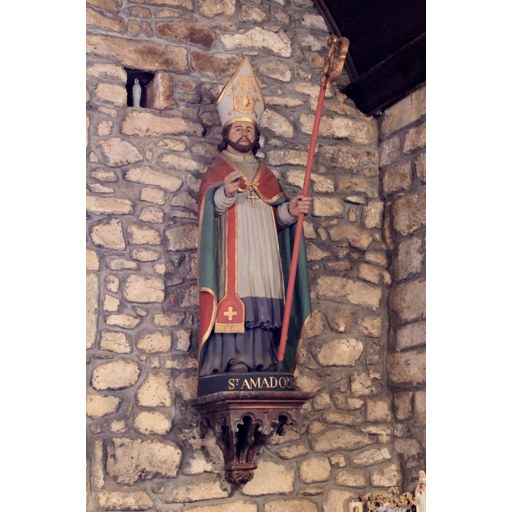
XIIIfromTOKYO
License: CC BY-SA 3.0
Amator of Auxerre
Saint- Life Span
- d. 418
- Feast Day
- 1 May
- Gender
- male
- Church
- Catholic
Places
Roles & Family
Religious Information
Biography
Saint Amator, also known as Amatre, Amadour, or Amatore, was bishop of Auxerre in late Roman Gaul during the late fourth and early fifth centuries. He is traditionally held to have occupied the see from 388 until his death on 1 May 418. Almost nothing about him can be established from strictly contemporary documents. The principal witnesses are the Life of Saint Germanus of Auxerre written by Constantius of Lyon in the later fifth century, a hagiographical Life of Amator attributed to Stephen of Africa, and the ninth-century Gesta pontificum Autissiodorensium, which preserves the local episcopal tradition of Auxerre. These sources present him as a native of Auxerre and as the immediate predecessor of the far better-known Saint Germanus.
According to the later vitae, Amator belonged to a wealthy family of Auxerre and was married to a woman named Martha. The hagiographers describe the marriage as a virginal union lived in continence, and they do not record any children. He was ordained priest by Bishop Valerian of Auxerre and, after Valerian’s death, was chosen to succeed him as bishop. In this office he is portrayed as an opponent of residual pagan custom in the Auxerrois. The episode most often repeated in connection with his episcopate concerns Germanus, then a high-ranking Gallo-Roman official. Germanus is said to have displayed hunting trophies on a pear tree that still carried associations with pre-Christian cult. Amator had the tree felled. After a confrontation he tonsured Germanus, ordained him to the clergy, and declared that God had designated Germanus to be the next bishop of Auxerre. Germanus accepted the change of life and in due course did succeed Amator.
Amator is further credited with obtaining relics of the martyr Saint Symphorian from Autun and with building a basilica outside the walls of Auxerre to receive them. He died, according to the Auxerre tradition, on 1 May 418 and was buried in that church. Germanus followed him in the see and became one of the outstanding bishops of fifth-century Gaul, which in turn kept Amator’s name alive in local liturgical memory. His feast day is 1 May. He was venerated as a saint from the early Middle Ages without a formal papal canonization of the later medieval or modern type, and he is not recorded as having belonged to a religious order.
From the twelfth century onward, the sanctuary of Rocamadour in Quercy promoted a legendary identification of its hermit Saint Amadour with Amator of Auxerre, claiming that the bishop had ended his life as a hermit in the cliff-side sanctuary. Modern historical scholarship treats that identification as a medieval cult legend rather than a demonstrated fact. The historically safer picture remains that of a late antique bishop of Auxerre whose career is known only in outline and whose detailed biography depends on hagiography composed well after his death. He was neither pope nor patriarch; he belongs to the secular episcopate of Roman Gaul, and many of the picturesque incidents attached to his name cannot be independently verified.