Ambrose of Optina is a saint of the Catholic Church (1812 - 1891). Ambrose of Optina's feast day is celebrated on October 10.
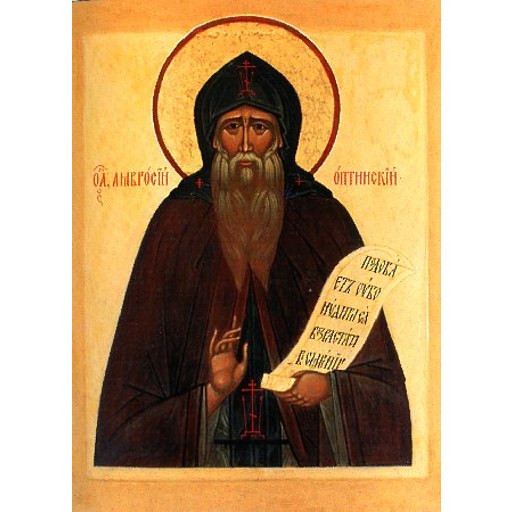
Original uploader was ru:Участник:Lozman at ru.wikipedia
License: Public domain
Ambrose of Optina
Saint- Life Span
- 1812 - 1891 (age 79)
- Feast Day
- October 10
- Gender
- male
- Church
- Catholic
Places
Roles & Family
Canonization
Biography
Ambrose of Optina was born Alexander Mikhailovich Grenkov in 1812 in the village of Bolshaya Lipovitsa in the Tambov Governorate of the Russian Empire, the son of a village sexton. He received a standard clerical education of the period, studying at the Tambov Theological School and then at the Tambov Theological Seminary, from which he graduated in the mid-1830s. After seminary he taught at the theological school in Lipetsk. In his mid-twenties a serious illness prompted him to vow that he would enter monastic life if he recovered. After a period of hesitation and further spiritual inquiry, including counsel from experienced monks, he left teaching and in 1839 entered the Optina Monastery (Optina Pustyn) near Kozelsk in the Kaluga Governorate, a house already known for the practice of starchestvo, or spiritual eldership.
At Optina he became a disciple of the elders Leonid (Lev Nagolkin) and, after Leonid’s death, Macarius (Ivanov). He was tonsured a monk in the early 1840s and given the name Ambrose in honor of Saint Ambrose of Milan, then ordained hierodeacon and subsequently hieromonk. Chronic illness soon compelled him to withdraw from regular liturgical and administrative obediences; he never fully recovered his health and for much of his later life received visitors while remaining seated or reclining. He continued to assist Elder Macarius, especially with the monastery’s large spiritual correspondence. After Macarius died in 1860, Ambrose became the principal starets of Optina and remained so for some three decades, the last of the great nineteenth-century Optina elders to hold that role in the imperial period.
Despite persistent physical weakness he received a constant stream of pilgrims of every social rank—peasants, merchants, clergy, intellectuals, and members of the nobility—offering brief, often pointed counsel that contemporaries described as combining spiritual discernment with homely humor and practical advice on family and daily life. Among those who sought him out were major figures of Russian culture. Fyodor Dostoevsky visited Optina in 1878 after the death of his young son, an encounter widely regarded as having shaped the portrait of Elder Zosima in The Brothers Karamazov. Leo Tolstoy also came to Optina on several occasions in the later nineteenth century. Ambrose’s letters and reported sayings circulated widely and formed an important part of the Optina pastoral tradition.
His work extended beyond the men’s monastery. In the 1880s he founded and spiritually directed the Kazan Ambrosievskaya women’s community at Shamordino, a convent intended in part for women of modest means and for those who could not easily be received in more established houses. He spent his final months at Shamordino and died there in October 1891; his body was taken back to Optina Pustyn for burial. He was already widely venerated in Russian Orthodox piety during his lifetime and after his death. The Local Council of the Russian Orthodox Church glorified him as a saint in 1988, in connection with the millennial commemoration of the Baptism of Rus'. His relics rest at Optina Monastery. The Russian Orthodox Church commemorates him on 10 October according to the Julian calendar (corresponding to 23 October on the civil calendar in the modern Russian usage), as well as on the day of the uncovering of his relics and together with the other Optina elders. He is remembered as a central figure in the Optina tradition of spiritual eldership in nineteenth-century Russia.