Amico di Rambona is a saint of the Catholic Church. Amico di Rambona's feast day is celebrated on 3 November.
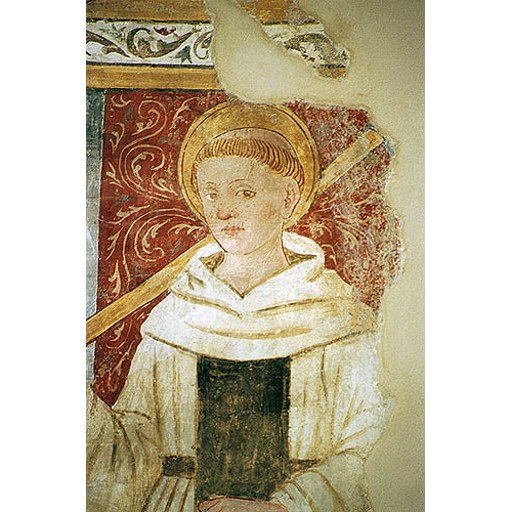
Mancervi
License: CC BY-SA 4.0
Amico di Rambona
Saint- Feast Day
- 3 November
- Gender
- male
- Church
- Catholic
Places
Roles & Family
Religious Information
Biography
Amico di Rambona, also known in Latin as Amicus, was a medieval Italian Benedictine monk and abbot of the Abbey of Santa Maria di Rambona, in the territory of present-day Pollenza in the province of Macerata, in the Marche of central Italy. Contemporary written evidence for his life is extremely thin, as is typical of many locally venerated monastic figures of the early and high Middle Ages. Later hagiographic and local tradition remembers him as a holy abbot who ruled the community of Rambona and was honoured as a saint after his death. Neither a verified year of birth nor a securely documented year of death has been established by modern historical research; he is generally situated in the Benedictine world of the Marche in or around the tenth and eleventh centuries. He is not to be confused without evidence with other Italian saints of the same name, including the hermit Sant'Amico whose relics were later associated with San Pietro Avellana.
The Abbey of Santa Maria di Rambona stood in a rural setting in the March of Ancona, a region that in the early Middle Ages lay at the meeting point of Lombard, Frankish, papal, and later imperial influence. Later legend sometimes ascribed the foundation of the house to the Carolingian age, even to Charlemagne or to Queen Hildegard, but such foundation stories are not historically demonstrated. The monastery is attested in medieval documentation as a Benedictine community dedicated to the Virgin Mary and, like other abbeys of the Marche, would have followed the Rule of Saint Benedict, joining the opus Dei of liturgical prayer with manual work and the administration of estates. Abbots of such houses were both spiritual fathers of their monks and, in practical terms, local lords, responsible for internal discipline, for relations with bishops and secular powers, and for the dependents who lived on monastic lands. It is in that setting that Amico is said to have served as abbot.
Surviving notices do not preserve a detailed medieval vita of Amico with a sequence of miracles, journeys, or a closely dated career. No authentic life comparable to the great Benedictine biographies of the period is known to have come down, and it is likely that his cult grew from the memory of a respected abbot inside his own monastery and its neighbourhood rather than from a widely circulated legend. In this he resembles many Italian monastic saints whose names were kept in local calendars, necrologies, and the care of relics, while the particulars of their earthly lives faded. Claims about specific deeds, visions, or precise dates must therefore be treated with caution. What the tradition does consistently affirm is his identity as a professed Benedictine, bound to the celibate monastic life; he is not recorded as having had a spouse or children, and he never held the see of Rome or a patriarchal office of the Eastern churches.
After his death Amico was buried at the abbey. The monastic church of Santa Maria di Rambona, which retains important Romanesque fabric, including a crypt, remained the centre of his memory. Local veneration of the holy abbot continued in the Marche, and he has been counted among the saints of the Benedictine family. His feast has traditionally been observed on 3 November in calendars associated with his cult. Formal papal canonization in the later medieval or modern sense is not documented for him; his recognition belongs to the older pattern of local cult, typical of many saints whose honours grew up before the centralized procedures of the Congregation of Rites, rather than to a dated act of beatification or canonization by a named pope. No reliable historical source assigns him a list of specialized patronages of the kind attached to more famous saints, nor does it preserve a birthplace or family origin.
The historical record, then, yields a modest but coherent picture: a Benedictine abbot of Santa Maria di Rambona, venerated locally in the Marche after his death, whose personal chronology and biography remain largely unknown. The abbey itself, after centuries of Benedictine life, eventually ceased to function as an independent monastic house, but the site and its church still witness to the medieval community that remembered Amico as its holy abbot. Serious hagiography can only report that scarcity of evidence rather than fill it with conjecture.