Amun is a saint of the Catholic Church. Amun's feast day is celebrated on 4 October.
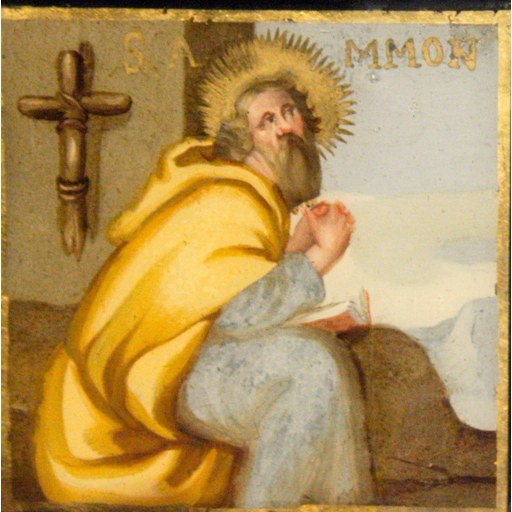
Amadalvarez
License: CC BY-SA 4.0
Amun
Saint- Feast Day
- 4 October
- Gender
- male
- Church
- Catholic
Places
Roles & Family
Biography
Saint Amun, also known as Ammon, Amon, or Amoun of Nitria, was a Christian monk of fourth-century Egypt and one of the Desert Fathers. He is regarded as the founder of the monastic settlement of Nitria in the western Nile Delta, which, together with Kellia and Scetis, formed the classic triad of Egyptian desert monastic centres. Knowledge of his life depends chiefly on three early sources: the Lausiac History of Palladius of Galatia, the Ecclesiastical History of Sozomen, and the Life of Anthony by Athanasius of Alexandria. These writers present him as a contemporary of Anthony the Great and as a man whose reputation for asceticism was already established in the first half of the fourth century. He held no episcopal, patriarchal, or papal office, and he belonged to no later formal religious order; he was a desert monk in the earliest Egyptian tradition.
Palladius relates that Amun belonged to a well-to-do Egyptian family and was left an orphan. When he was about twenty-two years of age an uncle compelled him to marry. On the wedding night he is said to have read to his bride from the seventh chapter of the First Epistle to the Corinthians, concerning those who have wives living as though they had none, and the couple agreed to remain together in continence. For eighteen years they shared a household, he occupied with garden work and the cultivation of balsam, she with spinning wool, without consummating the marriage. Eventually, at the wife’s suggestion, they separated so that each might follow a stricter way of life and avoid giving scandal. She gathered other virgins around her. He withdrew into the then little-occupied desert region of Nitria and there began the settlement that would bear that name. The wife’s name is not preserved in the ancient sources, and the couple are not recorded as having had children.
At Nitria Amun became the spiritual father of a growing number of disciples. Later estimates that thousands of monks inhabited Nitria reflect the expansion of the community in the generations after him rather than conditions in his own lifetime. Ancient narratives ascribe miracles to him. Athanasius tells that Amun, from a sense of modesty, would not undress in order to wade a canal or river, and that he was borne across by an angel; Anthony is said to have known and recounted this story. Athanasius further records that Anthony, dwelling on his inner mountain many days’ journey from Nitria, saw Amun’s soul being carried to heaven by angels and announced the death to those with him, a report afterwards confirmed. The earliest texts do not give an exact year of birth or death. Because the vision is placed in Anthony’s lifetime, Amun died no later than the mid-fourth century; later tradition commonly assigns the death to about the year 350. The precise place of burial is not independently recorded, but it would have been in or near Nitria in Egypt.
Amun left no writings that can be attributed to him with certainty. Later hagiography sometimes confuses him with other fourth-century monks named Ammon or Ammonas, notably a disciple of Anthony who led the community at Pispir; the founder of Nitria is the figure described by Palladius, Sozomen, and Athanasius. He is venerated as a saint in the Coptic Orthodox Church, the Eastern Orthodox Church, and the Roman Catholic Church. The Roman Martyrology and many Eastern calendars keep his feast on 4 October. No specific patronages of places, professions, or causes are securely attached to him in the standard martyrologies. His historical importance rests on the foundation of Nitria, which became a major school of Egyptian monasticism and, through pilgrims and literary reports, influenced Christian ascetic practice well beyond Egypt.