Ana de San Agustín is a venerable of the Catholic Church (1555 - 1624).
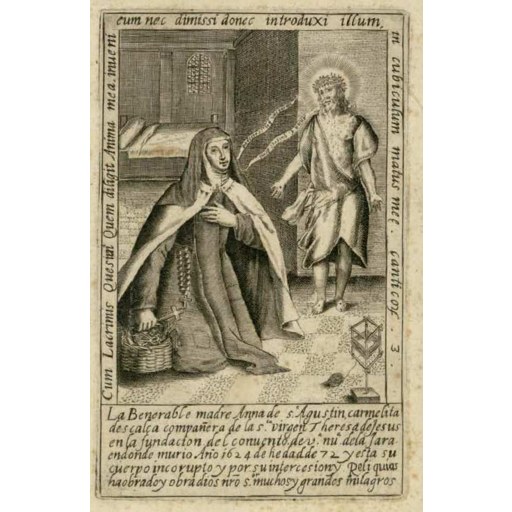
Anónimo, siglo XVII
License: Public domain
Ana de San Agustín
Venerable- Life Span
- 1555 - 1624 (age 69)
- Gender
- female
- Church
- Catholic
Places
Roles & Family
Religious Information
Biography
Ana de San Agustín, in the world Ana Pedruja Requena, was born on 11 December 1555 in Almodóvar del Campo, a town of La Mancha in the Crown of Castile, in what is now the province of Ciudad Real, Spain. She grew up in the Catholic culture of sixteenth-century Castile, a period shaped by the Council of Trent and by the multiplication of reformed religious houses. Surviving independent documentation of her childhood is thin; later Carmelite tradition holds that she was drawn early to prayer and to a consecrated life, but the details of her family beyond her secular name are not firmly established in the historical record.
In 1575, at about twenty years of age, she entered the Discalced Carmelite monastery of San José in Malagón, a house of the Teresian reform that Teresa of Ávila had founded in 1568. Carmelite sources state that Teresa herself invested her with the religious habit and that she took the name Ana de San Agustín. She was thus formed among the first generations of nuns who lived Teresa’s constitutions: strict enclosure, the Divine Office, mental prayer, and evangelical poverty. Malagón belonged to the early Castilian network of the reform, and Ana’s entry placed her in contact with the foundress and with the houses then spreading through New Castile.
In February 1580 she was among the nuns sent from Malagón to establish a new Discalced Carmelite convent at Villanueva de la Jara in the province of Cuenca, a foundation in which Teresa of Ávila took part and which she later described in her Book of the Foundations. Ana remained at Villanueva de la Jara for the rest of her life, some forty-four years. She held community offices, including periods as prioress, and was remembered in the internal tradition of the house for obedience, humility, and fidelity to the Teresian way. Later hagiography ascribes to her mystical graces; those reports belong to the pious literature of her cult and are not independently corroborated as historical fact.
She died in the convent at Villanueva de la Jara on 11 December 1624, the sixty-ninth anniversary of her birth, and was buried in that house. A local reputation for holiness persisted in the Carmel of La Mancha. A cause for beatification was later introduced, and she was declared Venerable by Pope Pius VI on 15 September 1776. She has not been beatified or canonized. She is remembered as one of the early Discalced Carmelite nuns of the Teresian reform in Castile, associated with the communities of Malagón and Villanueva de la Jara in the late sixteenth and early seventeenth centuries.