Anatolius of Nicaea is a saint of the Pre-Schism (Universal) Church.
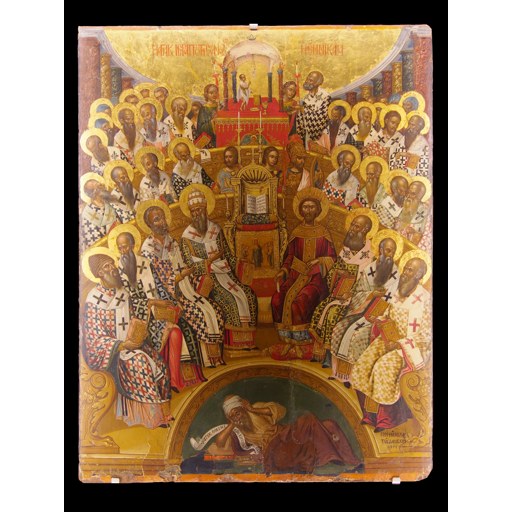
C messier
License: Public domain
Anatolius of Nicaea
Saint- Gender
- male
- Church
- Pre-Schism (Universal)
Places
Roles & Family
Biography
Anatolius of Nicaea is a poorly attested figure in Christian hagiography, known chiefly by a toponymic that links him to the ancient city of Nicaea in Bithynia, in northwestern Asia Minor (the site of modern İznik in Turkey). Nicaea was a major episcopal see of the early church and the meeting place of the First Ecumenical Council in 325 and the Seventh Ecumenical Council in 787. In later calendars and catalogues of saints, “of Nicaea” ordinarily means that a man held that bishopric or that a martyr or confessor was associated with the city or its region. No dedicated Life, passion narrative, or contemporary chronicle entry has been identified that would permit a secure reconstruction of this Anatolius’s career, dates, or the circumstances of his death.
The personal name Anatolius (Greek Anatolios) was relatively common among Greek-speaking Christians in late antiquity and the early Byzantine period. It is therefore essential not to conflate this subject with better-documented homonyms: Anatolius of Laodicea, the third-century Alexandrian scholar who became bishop of Laodicea in Syria, and Anatolius of Constantinople, a native of Alexandria who served as patriarch from 449 to 458 and took part in the Council of Chalcedon. Neither of those men occupied the see of Nicaea. Standard episcopal lists for Nicaea, drawn from conciliar subscriptions, the Notitiae episcopatuum, and the ecclesiastical historians, do not yield a clearly dated, independently corroborated bishop Anatolius whose biography can be written from those materials.
Without a vita, and without a notice in the principal recensions of the Synaxarion of Constantinople, the Byzantine Menaion, or the Roman Martyrology that can be matched unambiguously to a bishop or martyr of Nicaea named Anatolius, even a liturgical feast day cannot be assigned with confidence. Later compilations sometimes preserve isolated names attached to famous cities after the stories that once accompanied them have been lost. If Anatolius of Nicaea belongs to that class of tradition, he would have been remembered locally as a holy bishop, confessor, or martyr of the Bithynian church, but such a remembrance cannot be turned into a dated biography.
Because no reliable historical source supplies a year of birth or death, a place of origin distinct from the see, a place of burial, a record of marriage or children, or a list of patronages, those details must remain unspecified. Nicaea lay in the Roman and later Byzantine province of Bithynia and, in the developed patriarchal system, was subject to Constantinople; it was not itself a patriarchate. Nothing in the available evidence indicates that Anatolius of Nicaea held the office of pope or of patriarch. Any firmer identification would depend on a primary text—an inscription, a conciliar signature, or a localized synaxarial lemma—that has not been established in the standard reference literature of church history and hagiography.