Andrei Șaguna is a saint of the Catholic Church (1809 - 1873). Andrei Șaguna's feast day is celebrated on 30 November.
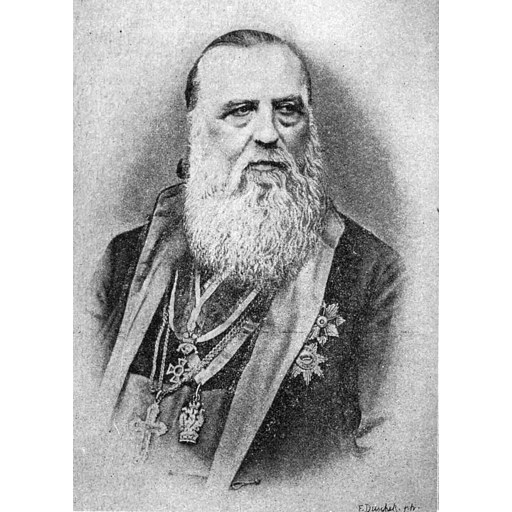
Unknown authorUnknown author
License: Public domain
Andrei Șaguna
Saint- Life Span
- 1809 - 1873 (age 64)
- Feast Day
- 30 November
- Gender
- male
- Church
- Catholic
Places
Roles & Family
Canonization
Biography
Andrei Șaguna was born Anastasie Șaguna on 20 January 1809 in Miskolc, in the Kingdom of Hungary, then part of the Austrian Empire. His family were Aromanians (Macedo-Romanians) of the Eastern Orthodox faith who had left the Ottoman Balkans and established themselves as merchants in the Habsburg lands. He received a thorough education, studying at Orthodox schools and then philosophy and law at the University of Pest, before turning to theology. In the early 1830s he entered monastic life at the Serbian monastery of Hopovo in Fruška Gora. There he was tonsured with the name Andrei, ordained deacon and priest, and advanced to archimandrite. He taught and held administrative posts under the Metropolitanate of Karlovci, the Serbian jurisdiction that then governed the Orthodox Romanians of Transylvania, the Banat, and neighboring regions.
The Transylvanian Orthodox bishopric had fallen vacant, and in 1846 Șaguna was named its general vicar. In 1848 he was consecrated Bishop of Transylvania at Sremski Karlovci. The same year he became a central figure in the Romanian national movement. He supported the great national assembly held at Blaj, which demanded recognition of the Romanians as a political nation, equality of the Orthodox Church, and Romanian-language education and administration. Șaguna traveled with delegations to the imperial court, submitted petitions, and argued against the union of Transylvania with Hungary on terms that would have left the Romanian majority without political standing. Although the revolutionary years ended in defeat for many national programs, he continued after 1849 to pursue church autonomy and civil rights by legal and diplomatic means.
As bishop and later metropolitan, Șaguna devoted himself to institutions. He created a diocesan printing press in Sibiu and issued liturgical books, school manuals, and a Romanian Bible. In 1853 he founded the newspaper Telegraful Român, which became an important organ of church and national opinion. He organized a network of elementary schools numbering in the hundreds, together with secondary schools and pedagogical institutes, so that the Orthodox Romanians of Transylvania might have teachers and clergy trained in their own language. In 1861 he took a leading part in founding ASTRA, the Association for Romanian Literature and the Culture of the Romanian People in Transylvania, and served as its first president. After prolonged negotiations, Emperor Franz Joseph restored the old Metropolitanate of Transylvania in 1864; Șaguna was raised to archbishop and metropolitan, with his residence at Sibiu. He then elaborated the Organic Statute of 1868, a constitutional charter for the metropolitanate that combined episcopal authority with synods in which parish clergy and lay delegates participated. The statute was confirmed by the emperor and remained influential in Orthodox church law.
Șaguna died in Sibiu on 28 June 1873 and was buried in the nearby village of Rășinari, the customary burial place of Transylvanian Orthodox metropolitans. His combination of canonical learning, administrative energy, and national advocacy made him the outstanding Romanian churchman of nineteenth-century Transylvania. The Romanian Orthodox Church numbered him among the saints in 2011, commemorating him on 30 November as a hierarch and confessor. He is remembered for restoring metropolitan rank to the Transylvanian church, for his school and press foundations, and for a model of church government that sought to involve the faithful in the life of the Orthodox community under Habsburg rule.