Andrew Dung-Lac is a saint of the Catholic Church (1795 - 1839). Andrew Dung-Lac's feast day is celebrated on 24 November. Andrew Dung-Lac is the patron saint of Vietnam.
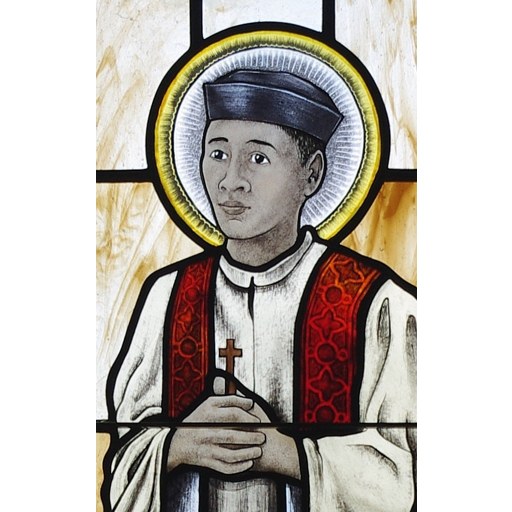
Nheyob (cropped by Rabanus Flavus)
License: CC BY-SA 3.0
Andrew Dung-Lac
Saint- Life Span
- 1795 - 1839 (age 44)
- Feast Day
- 24 November
- Gender
- male
- Church
- Catholic
Places
Roles & Family
Patronage
Vietnam
Canonization
Biography
Andrew Dũng-Lạc was born Trần An Dũng in 1795 to a poor non-Christian family in Bắc Ninh, in northern Vietnam. As a boy he left home to find work in the capital, Hanoi, where a Catholic catechist took him into his household, instructed him in the faith, and had him baptized with the name Andrew (Anrê). He studied Chinese letters, Latin, and theology and in time became a catechist himself, teaching doctrine and preparing others for baptism at a moment when the Church in Vietnam was growing but already under intermittent pressure from the imperial court.
He was ordained a diocesan (secular) priest in 1823 and was never a member of a religious order. He served in several parishes, preaching, administering the sacraments, and caring especially for the poor. During waves of persecution he sometimes changed his name, adding Lạc, and moved from place to place in order to continue his ministry. That ministry unfolded under the Nguyễn emperor Minh Mạng, whose edicts from the 1820s onward increasingly treated Christianity as a foreign political threat and forbade its practice.
Andrew was arrested in 1835 and ransomed by the faithful. He was seized again in 1839 and again redeemed. A third arrest that same year, together with the elderly priest Peter Trương Văn Thi, proved final. Both men were imprisoned, interrogated, and tortured; they refused to trample a crucifix or to recant. On 21 December 1839 they were beheaded in Hanoi. Andrew was about forty-four years old. Their deaths belonged to a much larger persecution in which tens of thousands of Vietnamese Christians, together with foreign missionaries, were killed between the seventeenth and nineteenth centuries.
He became the namesake of the group later known as Saint Andrew Dũng-Lạc and Companions, one hundred and seventeen martyrs chosen to represent that multitude (ninety-six Vietnamese, eleven Spanish Dominicans, and ten French missionaries). Sixty-four of them, including Andrew, were beatified by Pope Leo XIII on 27 May 1900. Pope John Paul II canonized the one hundred and seventeen in Rome on 19 June 1988. Their collective feast is kept on 24 November in the General Roman Calendar, and they are venerated as patrons of Vietnam. Historical sources do not record a surviving, publicly identified burial place for Andrew himself; as with many of the Vietnamese martyrs, his body was likely recovered in secret by the faithful or left without a marked tomb.