Andrew of Constantinople is a saint of the Catholic Church. Andrew of Constantinople's feast day is celebrated on 2 October.
AnonymousUnknown author
License: Public domain
Andrew of Constantinople
Saint- Feast Day
- 2 October
- Gender
- male
- Church
- Catholic
Places
Roles & Family
Biography
Andrew the Fool, known in Greek as Andreas Salos and often called Andrew of Constantinople, is a saint of the Eastern Orthodox Church commemorated as a fool-for-Christ. Almost everything that can be said about him derives from a single lengthy hagiographical composition, the Life of Andrew the Fool, written in the persona of a Constantinopolitan priest named Nikephoros who claims to have known the saint. The narrative situates Andrew in the imperial capital during the reign of Emperor Leo I in the fifth century and associates him with a young companion, Epiphanios, who is said later to have become patriarch. Modern philological study, especially the critical work of Lennart Rydén, has shown that this fifth-century setting is densely anachronistic. The Life was almost certainly composed in the middle of the tenth century, most often dated to the 950s. Whether a historical holy fool named Andrew lived in tenth-century Constantinople and was then recast in an earlier age, or whether the figure is substantially a literary creation, remains an open question among historians.
According to the vita, Andrew was a Scythian by origin, a designation that in Byzantine usage commonly referred to Slavs or to peoples from the northern Black Sea steppe. He was purchased as a slave in Constantinople by Theognostos, an officer in the imperial guard, and was educated so that he could serve as his master's secretary. After a divine vision he chose the path of salos, or foolishness for Christ's sake. He began to behave as if insane, was subjected to beating and public humiliation, and was in time released from slavery. Thereafter he lived as a homeless beggar in the streets, porticoes, and churches of Constantinople, sleeping among dogs, eating scraps, and accepting insults as a form of asceticism. The Life presents this apparent madness as a deliberate spiritual disguise, beneath which Andrew possessed gifts of clairvoyance, prophecy, and discernment of demons. He is nowhere described as having married or as having children; the entire portrait is that of an unmarried ascetic living in extreme poverty.
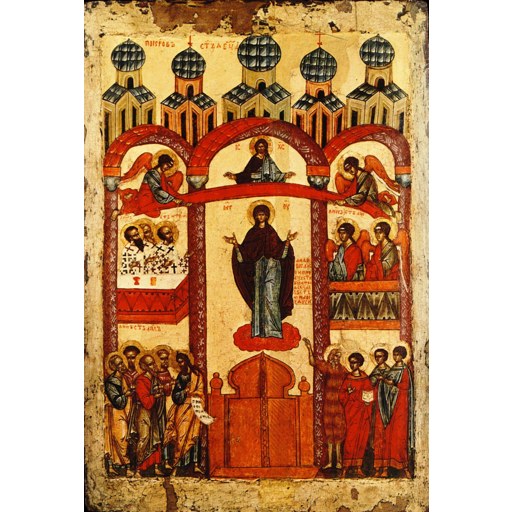
Andrew's closest disciple in the text is Epiphanios, a pious youth of good family whom the saint instructs in hidden wisdom. The most celebrated episode of the Life occurs during an all-night vigil in the Church of the Mother of God at Blachernae, where Andrew and Epiphanios behold the Theotokos enter the church, kneel in prayer, and then spread her veil over the people as a sign of protection. This vision became the narrative core of the Feast of the Protection of the Mother of God, or Pokrov, which was adopted with particular fervor in the Orthodox churches of the Slavic world and remains a major feast in the Russian tradition. The Life also attributes to Andrew a series of other revelations, including tours of heaven and hell and lengthy eschatological discourses on the fate of Constantinople and the last times. These apocalyptic sections circulated separately and influenced later Byzantine and Slavic prophetic literature.
Andrew is commemorated on 2 October in the Eastern Orthodox liturgical calendar. His cult belongs to the traditional Byzantine pattern of veneration and was not the product of a later formal canonization process of the Western type. No independent contemporary chronicle or official document confirms his birth, death, or even his historical existence; later synaxaria sometimes assign a death year in the tenth century, but such dates rest on hagiographical inference rather than verifiable record. He left no known writings of his own. His significance in Orthodox Christianity lies in the ideal of yurodstvo that his Life popularized, in the Blachernae vision that shaped Marian devotion in Rus', and in the vivid portrait the vita offers of street life, poverty, and unofficial holiness in medieval Constantinople.