Andrew of Crete is a venerable of the Catholic Church (d. 767). Andrew of Crete's feast day is celebrated on 17 October.
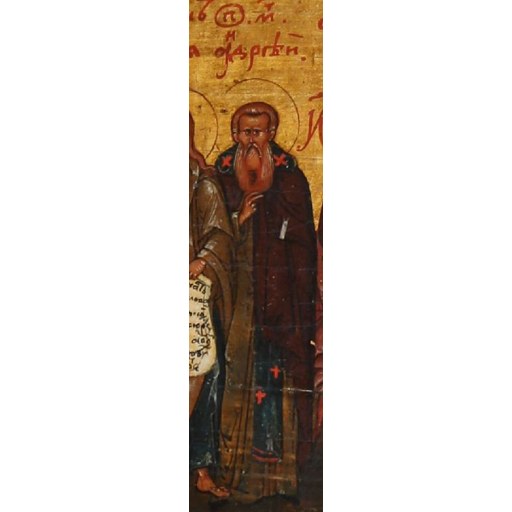
Anonymous Russian icon painter (before 1917)Public domain image (according to PD-Russia-expired)
License: Public domain
Andrew of Crete
Venerable- Life Span
- d. 767
- Feast Day
- 17 October
- Gender
- male
- Church
- Catholic
Places
Roles & Family
Biography
Andrew of Crete, also called Andrew of Krisei or Andrew who suffered at Krisis, was an eighth-century Christian martyr commemorated in the Eastern Orthodox Church. He is a different person from Saint Andrew of Crete the Hymnographer, the archbishop who composed the Great Canon and died a natural death around 740. The martyr is known almost entirely from later Byzantine synaxaria and liturgical notices rather than from contemporary chronicles. Those sources agree that he was a native of the island of Crete, then a Byzantine province, and that he was killed in Constantinople during the iconoclastic persecution under Emperor Constantine V. No reliable evidence survives for the year of his birth, his family, his education, or his occupation before he appeared in the capital.
The first period of Byzantine Iconoclasm, begun under Leo III and intensified under Constantine V (reigned 741–775), is the setting of his death. Constantine V, called Copronymus by iconophile writers, convened the Council of Hieria in 754, which condemned the making and veneration of icons. In the years that followed, images were destroyed in churches and those who defended them—especially monks, but also laypeople—faced humiliation, mutilation, exile, or execution. Hagiographical tradition presents Andrew as a pious Christian from Crete who, hearing of these measures, went to Constantinople to protest.
According to the received account, he publicly rebuked the emperor or imperial officials for destroying holy images and persecuting those who venerated them. He was arrested, beaten, and dragged through the streets of the city. He died of his injuries at a locality named Krisis (Krisei) in the capital. Liturgical sources assign the martyrdom to 17 October and commonly to the year 767, a date that is traditional rather than independently confirmed in eighth-century historiography. Christians are said to have recovered and buried his body. A church dedicated to him was later established at the site and became known as the Church, and subsequently the Monastery, of Saint Andrew in Krisei, a documented religious house of medieval Constantinople.
His cult remained essentially Byzantine and Orthodox. He is honored as a martyr who resisted imperial iconoclasm at the cost of his life, and his feast is kept on 17 October. Some later calendars style him a monk-martyr, but the core narrative does not clearly establish whether he was a monk or a layman, and no spouse or children are recorded. He was neither Bishop of Rome nor a patriarch, and he belonged to no Western-style religious order. Standard sources attach no extensive list of patronages to his name. Beyond the outline of a Cretan Christian killed in Constantinople under Constantine V for defending icons, the historical record is sparse, and the details of torture and burial rest on hagiography compiled well after the events they describe.