Andrew is a saint of the Catholic Church. Andrew's feast day is celebrated on 30 November. Andrew is the patron saint of Scotland;Russia;Greece;Romania;Ukraine;Barbados;Patras;Amalfi;Burgundy;fishermen;fishmongers;sailors;singers;maidens;unmarried women;gout;sore throats.
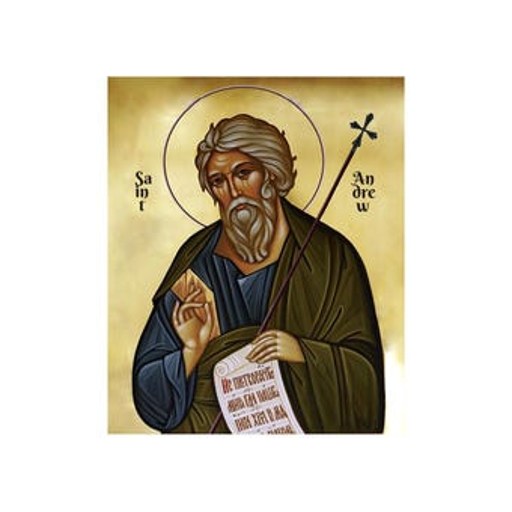
https://www.etsy.com/listing/937605845/saint-andrew-the-apostle-greek-orthodox
License: unknown
Andrew
Saint- Feast Day
- 30 November
- Gender
- male
- Church
- Catholic
Places
Roles & Family
Patronage
Scotland;Russia;Greece;Romania;Ukraine;Barbados;Patras;Amalfi;Burgundy;fishermen;fishmongers;sailors;singers;maidens;unmarried women;gout;sore throats
Biography
Saint Andrew, also called Andrew the Apostle and, in the Christian East, Andrew the First-Called, was one of the Twelve Apostles of Jesus Christ and the brother of Simon Peter. The Gospel of John identifies him as a native of Bethsaida in Galilee and the son of Jonah (or John). He worked as a fisherman on the Sea of Galilee with his brother. Before meeting Jesus he had been a disciple of John the Baptist. John's Gospel relates that Andrew heard the Baptist identify Jesus as the Lamb of God, followed Jesus, and then brought his brother Simon to him; this episode is the basis of the Greek title Protokletos, the First-Called. The Synoptic Gospels describe Jesus calling Andrew and Peter from their fishing nets to become fishers of men. In the New Testament Andrew is named in the apostolic lists; he draws attention to the boy with five barley loaves and two fish at the feeding of the five thousand; together with Philip he presents certain Greeks who wished to see Jesus; and with Peter, James, and John he questions Jesus privately about the coming destruction of the Temple.
Almost nothing about Andrew's later career can be established from contemporary historical evidence. Fourth-century tradition, reported by Eusebius of Caesarea and associated with Origen, held that Andrew preached in Scythia, north of the Black Sea. Other ancient and medieval traditions connected him with Cappadocia, Galatia, Bithynia, Thrace, and Greece. A Byzantine tradition claimed that he founded the church at Byzantium and ordained its first bishop, Stachys, a story that later supported the apostolic prestige of Constantinople. The apocryphal Acts of Andrew, generally dated to the second century and not treated as a reliable historical source in its narrative details, describes missionary journeys and a passion at Patras in Achaia.
Church tradition holds that Andrew was martyred at Patras in the Roman province of Achaia, in the Peloponnese of present-day Greece, by crucifixion. Later medieval accounts state that he was bound to an X-shaped cross, the crux decussata, thereafter called Saint Andrew's Cross; that particular form of the cross is not found in the earliest passion texts and appears to be a subsequent development of the legend. The year of his death is not known; tradition places it in the mid-first century. Relics attributed to him were said to have been translated to Constantinople in the fourth century and enshrined in the Church of the Holy Apostles. After the Fourth Crusade in the thirteenth century a substantial portion of the relics was taken to Amalfi in Italy, where they are still venerated in the cathedral. In 1964 Pope Paul VI returned the skull relic from the Vatican to Patras as an ecumenical gesture. A separate medieval legend, central to Scottish identity, asserted that relics of the apostle were brought to Fife by a bearer named Regulus (Rule), giving rise to the church and town of St Andrews and to Andrew's patronage of Scotland.
Andrew has been venerated across the Christian world from an early period. His principal feast is observed on 30 November in both Eastern and Western calendars. He is patron saint of Scotland, Russia, Greece, Romania, Ukraine, and Barbados, as well as of the cities of Patras and Amalfi, and he is invoked by fishermen, fishmongers, and sailors. The saltire associated with his martyrdom appears on the flag of Scotland and, through it, on the Union Flag, and it is also the distinctive emblem of the Russian naval ensign. In the Orthodox Church he is honored with particular solemnity as the First-Called apostle and, in Byzantine tradition, as a link between the apostolic age and the church of Constantinople.