Andrzej Bobola is a saint of the Catholic Church (1591 - 1657). Andrzej Bobola's feast day is celebrated on 16 May. Andrzej Bobola is the patron saint of Poland;Warsaw.
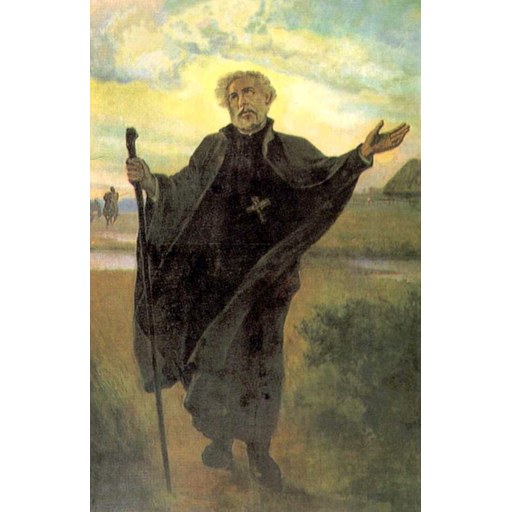
User Irpen on en.wikipedia
License: Public domain
Andrzej Bobola
Saint- Life Span
- 1591 - 1657 (age 66)
- Feast Day
- 16 May
- Gender
- male
- Church
- Catholic
Places
Relics & Where to Venerate
Location unknown
The bodily remains of Andrzej Bobola are a first-class relic. Venerated at Saint Andrew Bobola Sanctuary in Warsaw.
Roles & Family
Religious Information
Patronage
Poland;Warsaw
Canonization
Biography
Andrzej Bobola (known in English as Andrew Bobola) was born in 1591 at Strachocina, a village in the south-eastern part of the Kingdom of Poland, into a family of the Polish nobility. Little that is strictly contemporary survives about his childhood. In 1611, at Vilnius, he entered the novitiate of the Society of Jesus. He followed the Society’s course of humanities, philosophy, and theology in the Lithuanian province and was ordained a priest in 1622. In the years that followed he was employed as a preacher and pastoral worker in several Jesuit houses of the Polish-Lithuanian Commonwealth, including Vilnius, where he gained a reputation for energetic preaching and for care of the sick and the imprisoned.
From about the 1630s Bobola’s work shifted toward the missions of the eastern Commonwealth, in Lithuania and in Polesie. Jesuit reports of the period describe him as an itinerant missionary who visited scattered Catholic communities, instructed converts, and promoted the union of local Orthodox Christians with the Church of Rome, in the framework of the Union of Brest of the late sixteenth century. He held for a time the office of superior of the Jesuit residence at Bobruisk and later worked from Pinsk. The region was confessionally mixed and politically unstable; his activity, like that of other Latin and Uniate clergy, was later remembered by Catholic sources as apostolic and by some Orthodox sources as aggressive. The surviving evidence does not permit a full reconstruction of every journey, but it is clear that he spent the last decades of his life as a missionary rather than as a college professor or court preacher.
The mid-seventeenth century brought catastrophe to the Commonwealth: the Cossack uprising under Bohdan Khmelnytsky, Muscovite invasion, and the Swedish Deluge. In May 1657, while the eastern palatinates were occupied by Cossack and allied forces, Bobola was captured near Janów Poleski. Early Jesuit relations, composed from the testimony of witnesses, state that he was tortured over many hours and killed on 16 May 1657. The same accounts, which belong to the genre of martyrdom narratives, describe extreme physical cruelty; later hagiography repeated and amplified those details. His corpse was recovered and buried in the Jesuit church at Pinsk.
A cult grew after 1702, when, during another military emergency, the tomb was opened and the body was reported incorrupt. Relics were later moved to Polotsk and, after further translations in the nineteenth and twentieth centuries, including a period in Rome, were enshrined in Warsaw. Pope Pius IX beatified Bobola in 1853. Pope Pius XI canonized him in 1938, in a ceremony that also had a strong Polish national character on the eve of the Second World War. His liturgical feast is 16 May. He is venerated as a martyr of the Society of Jesus and as a patron saint of Poland; his principal shrine is the Sanctuary of Saint Andrew Bobola in Warsaw.