Angela of Foligno is a saint of the Catholic Church (1248 - 1309). Angela of Foligno's feast day is celebrated on 4 January. Angela of Foligno is the patron saint of Foligno;widows;those struggling with sexual temptation;people ridiculed for their piety;those who have lost children.
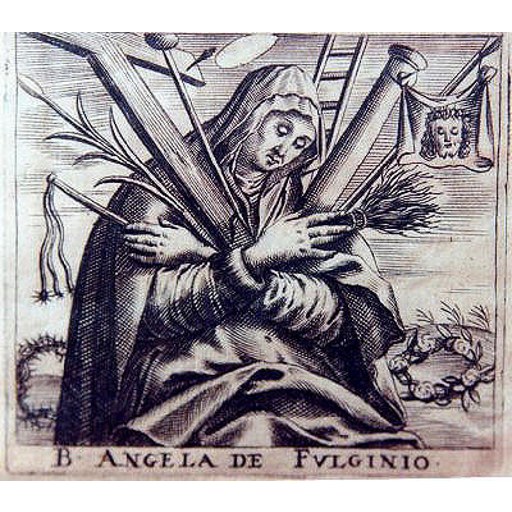
XVIIth century print
License: Public domain
Angela of Foligno
Saint- Life Span
- 1248 - 1309 (age 61)
- Feast Day
- 4 January
- Gender
- female
- Church
- Catholic
Places
Relics & Where to Venerate
Location unknown
The bodily remains of Angela of Foligno are a first-class relic. Venerated at Umbria.
Roles & Family
Religious Information
Patronage
Foligno;widows;those struggling with sexual temptation;people ridiculed for their piety;those who have lost children
Canonization
Biography
Angela of Foligno was born in 1248 in Foligno, a city in Umbria in central Italy, then within the Papal States. She came from a well-to-do family and married while still young, becoming the mother of several children. For much of her adult life she lived according to the habits of prosperous urban society, attached to comfort, appearance, and social standing. In the account later taken down from her own words she accused herself of serious faults, including long resistance to making a complete confession and sins against chastity. Toward the middle of the 1280s she underwent a conversion. Disturbed by the state of her soul and drawn to Saint Francis of Assisi, she sought a Franciscan confessor, made a general confession, and began a penitential life that gradually detached her from her former way of living.
Not long after this change of heart, her mother, her husband, and her children died in close succession, leaving her without immediate family. She disposed of landed property, gave generously to the poor, and about 1291 was received into the Third Order of Saint Francis, remaining in Foligno rather than entering a cloister. In that same year, during a pilgrimage to Assisi, she underwent a violent ecstatic experience in the basilica of Saint Francis; her cries attracted the attention of a Franciscan kinsman, Friar Arnaldo, who later became her confessor and the recorder of her inner life. Between roughly 1292 and 1296 Arnaldo compiled the Memorial, writing in Latin from Angela’s spoken Umbrian and describing a sequence of thirty steps by which she said she had been led from fear and penance toward transforming union with God. Later materials, known as the Instructions, preserve teachings she gave to a circle of men and women who gathered around her.
Angela’s mysticism centered on the Passion and humanity of Christ, on the Eucharist, and on a love of God that she described as passing through darkness, self-annihilation, and inexpressible joy. She combined these interior states with concrete works of mercy, including care for lepers and the destitute in and around Foligno. Although she lacked academic training, later readers named her Magistra theologorum, mistress of theologians, because of the doctrinal density of her reports of the Trinity and of Christ’s suffering. Franciscan writers of the early fourteenth century, among them Ubertino of Casale, treated her as an authority. She spent her last years as the spiritual mother of a mixed community of tertiaries and friars in her native city.
She died in Foligno on 4 January 1309 and was buried in the church of San Francesco there, where her tomb became a focus of local devotion. The Franciscan Order and the church of Foligno promoted her memory. Pope Innocent XII confirmed her cult and beatified her in 1693. On 9 October 2013 Pope Francis, by equivalent canonization, extended her veneration to the whole Catholic Church and inscribed her in the catalogue of saints. Her feast is kept on 4 January. The Book of Angela of Foligno remains a principal document of late medieval women’s mysticism and of Franciscan spirituality in thirteenth- and early fourteenth-century Italy.