Anian is a saint of the Catholic Church. Anian's feast day is celebrated on 25 November; 25 April. Anian is the patron saint of cobblers;shoemakers.
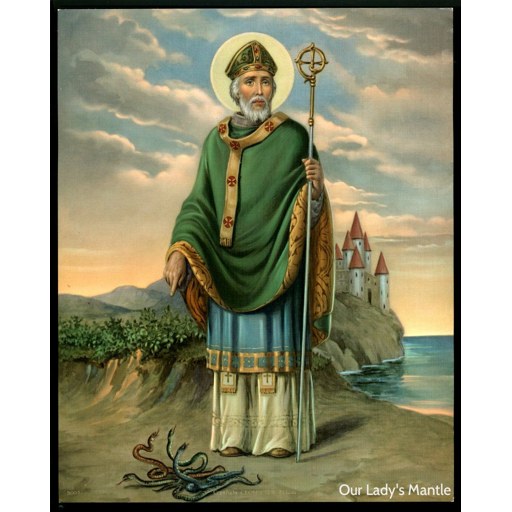
https://pinterest.com/ideas/pictures-of-saints/951106605671
License: unknown
Anian
Saint- Feast Day
- 25 November; 25 April
- Gender
- male
- Church
- Catholic
Places
Roles & Family
Patronage
cobblers;shoemakers
Biography
Anian, also known as Anianus or Annianus, is remembered as the second bishop of Alexandria and the immediate successor of Saint Mark the Evangelist in that see. He belongs to the first century of the Christian era and is counted by the Coptic Orthodox Church as the second Pope of Alexandria, an office that is also the patriarchate of that church. The earliest historical notice of him is in Eusebius of Caesarea, who states that Anian succeeded Mark in the eighth year of the emperor Nero and that he governed the Alexandrian church for twenty-two years, dying in the fourth year of Domitian. Later Coptic synaxaria and church histories expand this brief notice into a fuller, partly legendary vita. No reliable source records a year of birth, and even the year of death is given differently across traditions, commonly placed in the early to mid 80s of the first century. Independent Roman documentation of the Alexandrian Christian community in this period is extremely thin, so the Eusebian succession list remains the principal historical framework.
According to the conversion narrative preserved in Coptic and other Eastern sources, Anian was a native of Alexandria who worked as a cobbler or shoemaker. When Mark arrived in the city, a strap of the evangelist's sandal broke, and Mark sought out Anian to repair it. While working, Anian wounded his hand with his awl and cried out words understood as an invocation of the one God. Mark healed the injury, used the occasion to preach the Gospel, and converted Anian together with his household, whom he then baptized. The story cannot be verified from contemporary documents. It became, however, the foundation of Anian's later patronage of shoemakers and cobblers, and of the tradition that he was Mark's first convert in Egypt. Hagiographers present him thereafter as Mark's close collaborator in gathering the first Alexandrian congregation.
After a period of instruction, Mark is said to have ordained Anian and, before his own martyrdom or departure, to have designated him as bishop. As head of the Alexandrian church Anian is credited with organizing the growing Christian community, ordaining clergy, and continuing evangelization in the city and its surroundings. Sources describe him as a man of simple life and steadfast faith who guided the church through the decades after Nero, a time when Christians elsewhere in the empire faced intermittent hostility. He is generally said to have died in peace rather than by martyrdom, and to have been succeeded by Abilius (also called Avilius). Claims about the internal structure of the see, the number of churches, or specific missionary journeys beyond Alexandria rest on later narrative and should be treated as pious tradition rather than established fact.
Veneration of Anian is ancient in Egypt. The Coptic Orthodox Church commemorates him on 16 Hathor, corresponding to 25 November in the Gregorian calendar. The Eastern Orthodox churches and the Roman Martyrology have also listed him, commonly on 25 April. He is invoked as a patron of cobblers and shoemakers. Traditional accounts place his burial in Alexandria, associated with the church at Baucalis where Saint Mark himself was said to have been laid. Because almost all narrative detail beyond Eusebius derives from later hagiography, historians treat the conversion miracle and many particulars of his episcopate with caution, while still accepting that a bishop named Anian (Annianus) stood at the head of the Alexandrian church in the generation after Mark and that his memory was continuously honored in the Coptic succession of patriarchs.