Anna of Kashin is a saint of the Catholic Church (1280 - 1368). Anna of Kashin's feast day is celebrated on 12 June, 2 October. Anna of Kashin is the patron saint of Kashin;widows;mothers who have lost children.
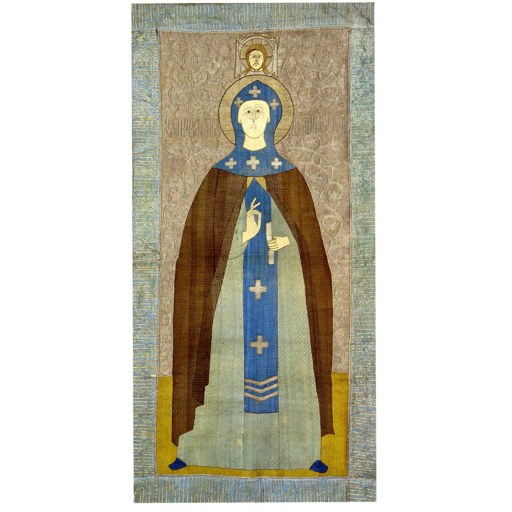
License: Public domain
Anna of Kashin
Saint- Life Span
- 1280 - 1368 (age 88)
- Feast Day
- 12 June, 2 October
- Gender
- female
- Church
- Catholic
Places
Roles & Family
Religious Information
Patronage
Kashin;widows;mothers who have lost children
Canonization
Biography
Anna of Kashin was a princess of the Rurikid house in northeastern Rus' during the period of Mongol overlordship. Traditional accounts place her birth about 1280 in Rostov, as a daughter of Prince Dmitry Borisovich of Rostov. In 1294 she married Prince Mikhail Yaroslavich of Tver, a match recorded in the Rus' chronicles and intended to bind Rostov and Tver. As princess of Tver she became the mother of several children, including Dmitry Mikhailovich, Alexander Mikhailovich, Konstantin Mikhailovich, Vasily Mikhailovich, and a daughter Feodora. Mikhail rose to the dignity of Grand Prince of Vladimir and entered a bitter contest with the princes of Moscow. In 1318 he was required to appear before Khan Uzbek of the Golden Horde and was put to death; the Church later venerated him as a passion-bearer and martyr.
The following decades brought further losses. Dmitry was executed at the Horde in 1326, and Alexander, after a turbulent career as prince of Tver, was killed there in 1339 together with his son Fyodor. Anna remained associated with Tver and, according to her later Life, received the monastic tonsure, taking the name Sophia. In the mid-1360s, after a destructive fire in Tver, she settled in Kashin, where her son Vasily ruled, and entered the convent at the Dormition church. Hagiographical tradition states that she took the great schema and resumed the name Anna. She died in Kashin on 2 October 1368 and was buried there.
Local honor of her memory continued in Kashin. In 1649 her relics were uncovered and described as incorrupt, and in 1650 Patriarch Joseph of Moscow and a council of the Russian Church formally numbered her among the saints, authorizing a feast, a vita, and liturgical services. The new cult soon collided with the liturgical reforms of Patriarch Nikon. Reports that the saint's hand was arranged in the two-fingered sign of the cross, together with historical errors in her Life and the use of her example by opponents of the reforms, led a council in 1677 under Patriarch Joachim to discontinue her public veneration, to have her name removed from calendars, and to order her icons altered. Her relics nonetheless remained in Kashin, and unofficial devotion did not entirely cease.
In the early twentieth century the question of her cult was reopened. After investigation, the Holy Synod of the Russian Orthodox Church restored her veneration in 1908, and a public celebration was held in Kashin in June 1909. She is commemorated on 2 October, the day of her repose, and on 12 June, recalling both the seventeenth-century uncovering of the relics and the restoration of her feast. Anna of Kashin is honored as the heavenly protectress of the town of Kashin and is invoked by the faithful in trials of family life, widowhood, and the death of children. Her relics, which were removed from church custody in the Soviet period, were later returned and are again venerated in Kashin.