Anna Vsevolodovna of Kyiv is a venerable of the Catholic Church (d. 1112).
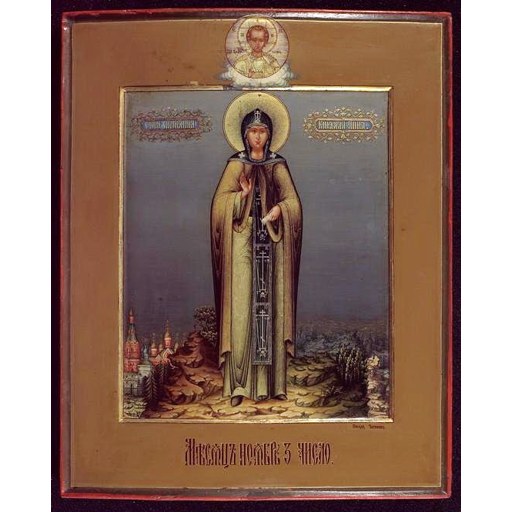
Osip Semenovich Chirikov
License: Public domain
Anna Vsevolodovna of Kyiv
Venerable- Life Span
- d. 1112
- Gender
- female
- Church
- Catholic
Places
Relics & Where to Venerate
Location unknown
The bodily remains of Anna Vsevolodovna of Kyiv are a first-class relic. Venerated at Kyiv.
Roles & Family
Religious Information
Biography
Anna Vsevolodovna, known in the East Slavic sources as Yanka or Ianka, was a Rurikid princess of Kievan Rus' whose life is attested in brief but important notices in the Primary Chronicle and related annalistic compilations. She was a daughter of Vsevolod I Yaroslavich, Grand Prince of Kiev (reigned 1078–1093), one of the sons of Yaroslav the Wise. The identity of her mother is not established with certainty in the surviving texts. Vsevolod’s first wife was a Byzantine noblewoman related to Emperor Constantine IX Monomachos and the mother of Vladimir Monomakh; after that wife’s death he married a Cuman princess often called Anna. Later genealogical reconstructions have assigned Anna Vsevolodovna to one or the other of these unions, but the medieval chronicles themselves do not specify which wife was her mother. She grew up at a court that maintained close political, marital, and ecclesiastical connections with Constantinople and with the steppe peoples on Rus's southern frontier.
In the 1080s her father established a church in Kiev dedicated to Saint Andrew. The Primary Chronicle records that his daughter Yanka took monastic vows at this church, assembled a community of nuns, and lived with them according to a monastic rule. The foundation is commonly identified as the convent of Saint Andrew, sometimes called the Yanchin monastery after her. This was one of the early female monastic houses in the Kievan lands. Anna’s role appears to have been that of foundress and leading figure of the community, though the sources do not use later technical titles such as abbess in a consistent way. The convent stood in the vicinity of other princely and ecclesiastical foundations that defined the sacred topography of eleventh-century Kiev.
In 1089 Anna undertook a journey to Constantinople. According to the chronicle, she returned to Kiev with a new metropolitan of Rus', John, who is sometimes distinguished in later lists as John the Eunuch or numbered as John III. The episode shows that a princess-nun could serve as an intermediary in the appointment of the head of the Rus' church, which remained under the canonical authority of the Patriarchate of Constantinople. After this mission she resumed her monastic life in Kiev. The chronicles do not preserve a detailed account of her remaining years, which coincided with the last part of her father’s reign and the subsequent rule of Sviatopolk II and then of Vladimir Monomakh.
Anna died on 3 November 1112, according to the date most often given in modern reference works; some chronicle traditions and later calculations yield 1113. She almost certainly died in Kiev, at or near the convent she had entered decades earlier. No contemporary vita or miracle collection survives, and many personal details—her year of birth, her childhood, and the precise place of burial—are unrecorded. Later East Slavic historical and ecclesiastical writing remembered her as a pious princess and monastic foundress. In some Orthodox local traditions she has been treated as a venerable nun, but she does not occupy a prominent place in the universal calendars of the Eastern Orthodox Church, and claims of formal canonization or a universally observed feast day are not securely documented in the major historical sources.
Nineteenth- and twentieth-century historians, especially in Russian and Ukrainian scholarship, often credited Anna with founding a school for girls at her convent, presenting it as an early institution of female education in Eastern Europe. This interpretation expands upon the chronicle’s statement that she gathered nuns and organized their common life; the medieval text itself does not describe a school in the later sense. The picture that can be verified is therefore more limited: a well-connected Rurikid woman who embraced monasticism, helped establish a female community in Kiev, and played a documented role in relations between the Kievan church and Byzantium at the end of the eleventh century. Her life illustrates the possibilities open to princesses in Kievan Rus' who chose the cloister rather than a dynastic marriage.