Anne-Marie Javouhey is a saint of the Catholic Church (1779 - 1851). Anne-Marie Javouhey's feast day is celebrated on 15 July.
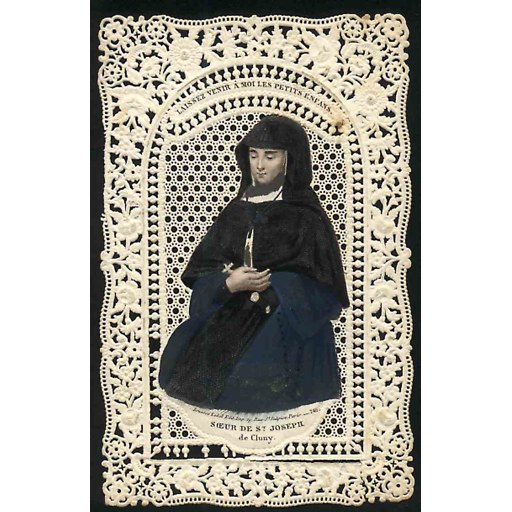
Unknown authorUnknown author
License: Public domain
Anne-Marie Javouhey
Saint- Life Span
- 1779 - 1851 (age 72)
- Feast Day
- 15 July
- Gender
- female
- Church
- Catholic
Places
Relics & Where to Venerate
Location unknown
The bodily remains of Anne-Marie Javouhey are a first-class relic. Venerated at Église Saint-Joseph-de-Cluny.
Roles & Family
Religious Information
Canonization
Biography
Anne-Marie Javouhey was born in 1779 in the Côte-d'Or in Burgundy, France, the fifth of ten children of Balthazar Javouhey, a well-to-do farmer, and his wife Claudine. Her childhood unfolded during the French Revolution, when the Civil Constitution of the Clergy, the suppression of religious houses, and the persecution of priests who refused the revolutionary oath transformed Catholic life. The Javouhey household remained attached to the non-juring clergy. As a girl she helped hide priests and received the sacraments in secret, experiences that shaped her conviction that the Church had to be defended and rebuilt after the revolutionary years.
After the Concordat of 1801 restored a legal framework for Catholicism in France, she sought religious life. She made a private vow of chastity in the early nineteenth century and tried her vocation in more than one existing community, including a period associated with the Sisters of Charity, but did not remain. Traditional accounts record a vision around 1805 in which she saw children of African and other origins, later read as a sign of missionary work. With several of her own sisters she began teaching poor children. A small community took shape at Chalon-sur-Saône around 1807; by 1812 it was established in a former monastic building at Cluny and took the name Sisters of Saint Joseph of Cluny. The institute combined the education of girls, care of the sick, and a willingness to accept missions in French territories overseas. As superior, Javouhey showed organizational talent and a readiness to deal directly with civil officials as well as bishops.
Overseas expansion began in the 1810s and 1820s with foundations on Réunion and in Senegal. Her most ambitious work was in French Guiana. From the late 1820s she spent years there, especially at Mana, directing a settlement for Africans who had been enslaved or were being prepared for emancipation. She organized land clearance, farming, workshops, and schools, and insisted on a disciplined communal life intended to ready residents for freedom. The project drew both praise and criticism. Colonial administrators and some clergy regarded her as overreaching; she in turn complained of obstruction. In France she was sometimes compared, not always kindly, to a female Napoleon for her energy and habit of command. Recurring disputes over the congregation’s constitutions and over her own authority did not stop the Sisters of Saint Joseph of Cluny from growing in Europe, Africa, the Indian Ocean, and the Americas.
Javouhey spent her last years directing the congregation from France and died in Paris in 1851. She was beatified by Pope Pius XII in 1950. Her feast is kept on 15 July. The congregation she founded remains an international missionary institute. Historical writing treats her as a major example of female religious leadership in post-revolutionary France and as a controversial participant in Catholic and colonial debates over slavery, education, and emancipation in the first half of the nineteenth century.