Anno II, Archbishop of Cologne is a saint of the Catholic Church (d. 1075). Anno II, Archbishop of Cologne's feast day is celebrated on 4 December. Anno II, Archbishop of Cologne is the patron saint of Siegburg.
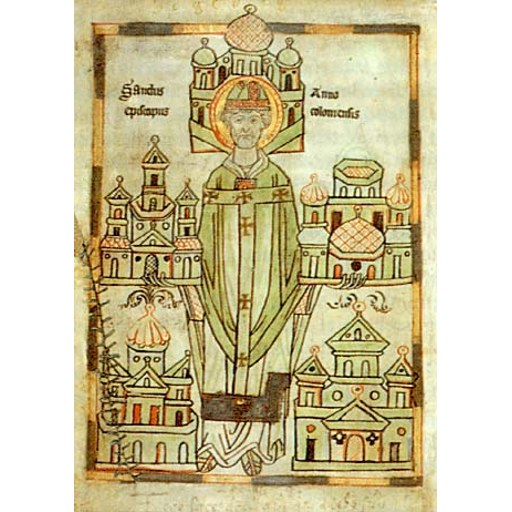
Unknown authorUnknown author
License: Public domain
Anno II, Archbishop of Cologne
Saint- Life Span
- d. 1075
- Feast Day
- 4 December
- Gender
- male
- Church
- Catholic
Places
Roles & Family
Patronage
Siegburg
Canonization
Biography
Anno II was Archbishop of Cologne from 1056 until his death in 1075 and one of the most powerful ecclesiastical princes of the Salian era in the Holy Roman Empire. He came from a Swabian noble family, the counts of Steusslingen, and received his education at the cathedral school of Bamberg, then a leading centre of clerical learning in the German kingdom. After serving among the clergy associated with the imperial court of Emperor Henry III, he was appointed to Cologne, a see that carried the office of archchancellor for Italy together with extensive lands and rights along the Rhine. Contemporary and near-contemporary sources present him as an ambitious, energetic prelate whose career combined pastoral administration, monastic patronage, and high politics.
In the unsettled years after Henry III’s death, when the Empress Agnes governed for the child Henry IV, Anno became a central actor among the German magnates. In 1062, in the episode known as the Coup of Kaiserswerth, he seized the young king from his mother’s custody on the Rhine and thereby transferred effective control of the court to a group of princes in which he himself was prominent. For a time he directed imperial business, later sharing influence with other churchmen such as Archbishop Adalbert of Hamburg-Bremen, until Henry IV began to rule in person. Anno used this position to strengthen the see of Cologne and to advance kinsmen, and he took part in the synods and papal negotiations of the 1060s that formed the background to the later Investiture Controversy. His methods were often high-handed, and later writers, including those favourable to him, did not conceal his severity.
As diocesan bishop he was a notable patron of eleventh-century monastic reform. He founded the Benedictine abbey of Siegburg in the 1060s on a hill above the Sieg, introducing monks from reformed houses in Italy and Lotharingia, and he established or restored other communities, including Saalfeld in Thuringia and Grafschaft. He endowed churches in Cologne, promoted the cult of relics, and sought to raise the standard of observance and liturgy in his diocese. These foundations tied his memory especially to Siegburg, where a vita was later composed. His relations with the growing urban community of Cologne were more fraught. Long-standing tensions between archiepiscopal lordship and the city’s merchants and burghers broke into open revolt in 1074, after an incident involving the seizure of a vessel; Anno was forced to leave Cologne for a time before reasserting his authority.
He died on 4 December 1075 and was buried at the abbey of Siegburg. Veneration began at his tomb, miracles were reported, and he was canonized in 1183 by Pope Lucius III. His feast is observed on 4 December. Medieval hagiography, above all the Siegburg Vita Annonis, portrayed him as a stern reformer and founder; modern historians treat him as a characteristic imperial bishop of the eleventh-century German kingdom, whose career illustrates both the reach of episcopal power in the Salian empire and its limits when confronted with urban communities and a monarchy coming of age.