Anselm of Canterbury is a saint of the Catholic Church (1033 - 1109). Anselm of Canterbury's feast day is celebrated on 21 April. Anselm of Canterbury is the patron saint of theologians;philosophers.
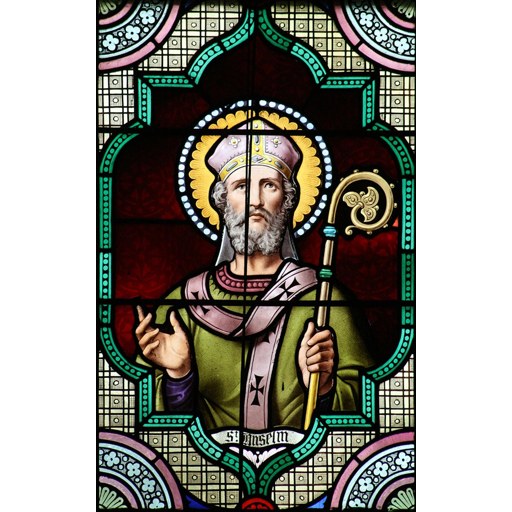
Unknown, English
License: Public domain
Anselm of Canterbury
Saint- Life Span
- 1033 - 1109 (age 76)
- Feast Day
- 21 April
- Gender
- male
- Church
- Catholic
Places
Relics & Where to Venerate
Location unknown
The bodily remains of Anselm of Canterbury are a first-class relic. Venerated at Canterbury Cathedral.
Housed at Canterbury Cathedral · United Kingdom
His remains were translated to Canterbury Cathedral and laid at the head of Lanfranc at his initial resting place to the south of the Altar of the Holy Trinity (now St
Roles & Family
Religious Information
Patronage
theologians;philosophers
Canonization
Biography
Anselm was born in Aosta, then in the Kingdom of Burgundy, in the early 1030s, the son of Gundulf, a Lombard landholder, and Ermenberga, who came from a Burgundian family of standing. His childhood and youth were spent in a frontier Alpine town whose political world was that of the western Empire rather than of the Italian communes that later claimed him as an Italian saint. According to his companion and biographer Eadmer, he lost his mother while still young, quarrelled with his father, and left home in his twenties. After a period of study and wandering in Burgundy and Francia he was drawn to the Norman abbey of Bec by the teaching reputation of Lanfranc. He entered Bec around 1059–1060, took monastic vows, and was ordained in the Benedictine community that would shape the rest of his life.
When Lanfranc left Bec for Caen in 1063, Anselm succeeded him as prior; on the death of the founder Herluin in 1078 he became abbot. The decades at Bec were his most productive as a writer. In the Monologion and the Proslogion he developed a rational account of God that begins from faith and seeks understanding (fides quaerens intellectum), including the argument later called ontological, which Gaunilo of Marmoutier famously challenged and which Anselm answered. He also wrote treatises on truth, free will, the fall of the devil, and the grammar of theological language. As abbot he travelled in Normandy and England, reformed dependent houses, and became known at the Anglo-Norman court. His correspondence from this period shows a pastor and teacher rather than a political prelate, though the Conquest had already bound Bec’s fortunes to England.
After Lanfranc’s death in 1089 the see of Canterbury remained vacant while William II Rufus kept its revenues. In 1093, during an illness, the king named Anselm archbishop. Anselm accepted only after insisting on restoration of church lands, recognition of Urban II as pope, and freedom to discharge the spiritual duties of the office. Conflict followed almost at once over royal exploitation of the church, knight-service from church lands, and the archbishop’s right to hold a reforming council and to go to the pope for his pallium. In 1097 Anselm left England without the king’s full consent, spent time at the papal court, and took part in the Council of Bari (1098), where he argued the Latin position on the procession of the Holy Spirit against Greek interlocutors. He remained in exile until William’s death in 1100. During these years he completed Cur Deus Homo, his major work on the Incarnation and atonement, framed as a satisfaction offered by the God-man.
Henry I recalled him, but a new dispute opened over lay investiture and clerical homage, part of the wider European struggle after Gregory VII. Anselm refused to consecrate bishops invested by the king or to do homage for his temporalities in the form Henry demanded. A second exile lasted from 1103 to 1107, during which he stayed mainly in France and Burgundy while envoys went to Rome. A settlement in 1107, sometimes called the Concordat of London, allowed the king a role in elections and homage for temporalities while reserving spiritual investiture with staff and ring to the church; it anticipated in England some of the terms later reached at Worms. Anselm returned, held councils that issued reforming canons, and continued to write, including on the procession of the Spirit and on predestination and free will. He died at Canterbury on 21 April 1109 and was buried in the cathedral. His cult grew in the later Middle Ages; Pope Alexander VI formally canonized him in 1494, and in 1720 Clement XI declared him a Doctor of the Church. Later tradition has regarded him as a principal founder of scholastic method and as a theologian whose ontological argument and satisfaction theory remained points of reference for centuries.