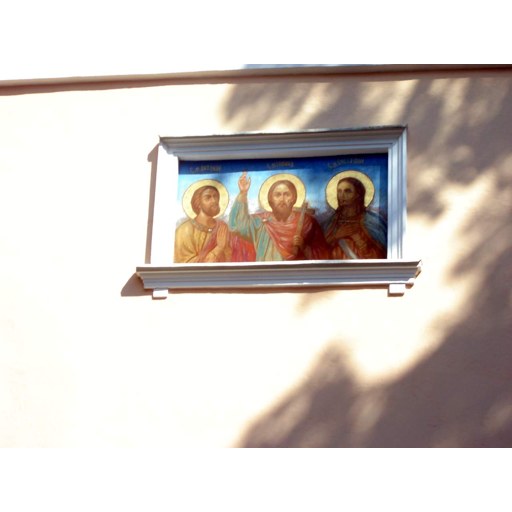
Anthony, John, and Eustathios is a saint of the Catholic Church (d. 1347). Anthony, John, and Eustathios's feast day is celebrated on 14 April.
Reytan
License: Public domain
Anthony, John, and Eustathios
Saint- Life Span
- d. 1347
- Feast Day
- 14 April
- Gender
- male
- Church
- Catholic
Places
Roles & Family
Biography
Anthony, John, and Eustathius, often called the Martyrs of Vilnius, were Lithuanian Orthodox Christians put to death in Vilnius in the mid-fourteenth century. Traditional hagiographical sources present them as men of pagan birth who served as courtiers of Grand Duke Algirdas. Their Lithuanian names are given as Kruglets, Kumets, and Nezhilo; they received the Christian names Anthony, John, and Eustathius at baptism. The priest who baptized them is named Nestor in the vitae. Anthony and John are frequently described as brothers, while Eustathius is portrayed as a younger companion. No reliable source records a year or a specific town of birth for any of the three, beyond their origin among the Lithuanians of the Grand Duchy.
In the 1340s the Grand Duchy of Lithuania remained officially pagan, even though Algirdas, who became grand duke in 1345, was married to an Orthodox princess, Maria of Vitebsk, and tolerated an Orthodox presence in the capital, including a church of St. Nicholas. Court ceremonial still involved pagan custom. According to the received narrative, the three converts refused to eat meat during a Christian fast at a ducal feast and declined to cut their hair and beards in the manner expected at court, thereby marking themselves publicly as Christians. They were imprisoned and tortured. Anthony was hanged first from an oak tree. John, after a period of confinement during which some accounts say he briefly faltered and then reaffirmed his faith, was hanged from the same tree. Eustathius suffered a longer passion: the vitae describe the breaking of his legs, the tearing of hair and skin from his head, and exposure to cold before he too was hanged from the oak. The traditional year given for these events is 1347.
The oak of their execution became a place of local devotion, and a church dedicated to the Holy Trinity was later built on the site. The martyrs were first buried at the church of St. Nicholas in Vilnius. Their relics were subsequently reported incorrupt and were translated to the Cathedral of the Theotokos in Vilnius. When that cathedral passed into Catholic use in the later sixteenth century, the relics were moved to the Orthodox Monastery of the Holy Spirit in Vilnius, where they remain enshrined. The three are glorified as saints in the Orthodox Church and are commemorated together on 14 April. They are among the earliest saints associated with Lithuania and are especially venerated in the Orthodox communities of Lithuania, Belarus, and Russia. Icons customarily show them together, often with the oak of their martyrdom.
Independent contemporary Lithuanian documentation of their trial is lacking. The narrative depends on later Orthodox synaxaria and vitae, which took shape as their cult spread in the Russian Church and among the Orthodox of the Grand Duchy. Precise biographical data such as dates of birth, family beyond the tradition that two were brothers, and any marriages or children are not preserved in the sources that survive.